

7 BREW
Drive-thru coffee store with multi-unit commitments
Own and operate a high-capacity drive-thru, quick-serve coffee store under the “7 BREW®” name that primarily sells coffee, coffee-based, and other beverages. The franchise is structured as multi-unit development of at least 10 “traditional” Stores within a defined territory.
Free Independent Franchise Consultant follow-up within 24 hours.
Traditional 7 BREW Store franchise with 10-store development commitment
Explore details ↓7 BREW reports Fiscal Year 2025 annual Total Sales for stores that were open and operating for the full year. It gives one combined store group, one franchised-only group, and one company-owned group. The reported figures are per location, not per business or territory. The document also says the averages do not show costs or profit.
Explore details ↓You must run the Store under 7 Brew’s Brand Standards, buy many items and services only from approved or designated sources when required, and follow approval rules for suppliers, marketing, and development.
Explore details ↓How owning a 7 BREW Store works
A “traditional” 7 BREW Store must have at least one drive-thru window. Franchisees must commit to develop at least 10 Stores by signing a Development Rights Rider (DRR) and operate the Store in accordance with required Brand Standards and product/service requirements. Ownership may be done directly or through “Approved Affiliates” that are at least 75% (often reduced to as low as 51%) controlled by the franchisee or its owners.
Business model · PDF 1, 11 ↗What you’d be running
You must run the Store under 7 Brew’s Brand Standards, buy many items and services only from approved or designated sources when required, and follow approval rules for suppliers, marketing, and development.
Owner responsibilities & training
Required training is provided virtually/at distance and, at franchisor option, at a designated training location; attendees include the ownership group (Managing Owner), store managers, and hourly employees. The Initial Training is structured as three components: a 2-day program for ownership, a 14-day program for store management and above, and a 3-day program for hourly employees. Management training is expected to occur after signing and while you develop the store, and store managers must complete Initial Training and pass tests to be certified before opening; the store must have two fully trained managers on-site. Ongoing training may be required, but the franchisor states limits of no more than 3 consecutive days and no more than 5 total days per calendar year; you pay compensation and expenses during training. If you request additional/special guidance or supplemental training beyond what is provided, you must pay daily charges and travel/hotel/living expenses. Travel and other participant expenses during training are on the franchisee/employee side (wages, benefits, travel, hotel, food), and you must also cover retraining compensation/expenses and any fees for locally provided training (including the franchisor’s then-current training fee and its travel/living). Separately from training, pre-opening assistance includes site review tied to your identified sites and acceptance processes, template plans/plan pre-approvals/inspections, and optional opening-team support during the opening phase at the franchisor’s option (and brand fund may pay wages and travel-related expenses for an opening team). There is also a computer system requirement, with ongoing maintenance/support renewal and costs estimated in the FDD (not provided as training tuition). Tuition vs. travel: the FDD states Initial Training is “for no additional fee,” but it also states you must pay employees’ wages/benefits and travel/hotel/food expenses while they attend training. For any additional/special guidance or training beyond that, the FDD requires you to pay daily charges plus travel/hotel/living expenses. For retraining, you must pay all employee compensation and expenses during retraining. For supplemental/ongoing training beyond basic attendance limits, fees are described as up to $1,500 per trainer per day plus certain expenses, and you pay compensation and expenses for attending training courses/programs. The FDD also notes that if you request locally provided training, you pay the franchisor’s then-current training fee and its travel/living expenses (subject to availability).
You must run the Store under 7 Brew’s Brand Standards, buy many items and services only from approved or designated sources when required, and follow approval rules for suppliers, marketing, and development. Your Store is tied to a specific accepted site, and any development territory does not give you exclusivity because 7 Brew can still place non-traditional stores and other channels in or around the area. Ownership participation is also active: you must appoint a pre-approved Managing Owner, keep at least two fully trained on-site managers, and the Managing Owner must have authority to make binding decisions. Having managers does not by itself make the business semi-absentee. You also may sell only authorized products and services at the Store, and 7 Brew can change the product mix and service rules over time. You must operate to Brand Standards, use approved or designated suppliers when required, obtain pre-approval for new suppliers and marketing changes, and accept that 7 Brew may limit or revoke supplier approvals. You must name a pre-approved Managing Owner from among your individual owners, maintain at least two fully trained on-site managers, and have owners with at least 25% interests personally guarantee the franchise obligations unless the franchise agreement waives or limits that requirement. You must sell only authorized products and services at the Store, and you may not use unapproved sales channels. For territory, you may operate only at the accepted site, cannot relocate without written consent, and any development rights do not create exclusivity because 7 Brew and its affiliates retain broad rights to operate or authorize other businesses in and around the area.
Read the FDD · PDF 28, 29, 30, 31, 32, 33, 34, 35, 36, 38, 39, 40, 41, 42, 43, 44, 45, 46, 47, 48, 49, 50, 51, 52, 57, 58 ↗What it costs to open and operate.
The startup range is your opening estimate. The fee schedule shows the charges and conditions that continue after opening.
Initial investment for a new traditional 7 BREW Store assumes a 10-store commitment. Additional funds cover 3 months of operation; the franchisor does not offer direct or indirect financing.
Explore my investment budget ↗View all 31 fees & conditions
| Fee | Amount / basis | When due | Notes |
|---|---|---|---|
| Initial franchise fee | $35,000 for the first 7 BREW Store; $25,000 for the 2nd and each subsequent Store under a Development Rights Rider | $35,000 due in a lump sum when you sign the Franchise Agreement for your first Store; $25,000 due within 5 days after you open the 2nd and each subsequent Store | Not refundable. If you buy an existing Store from a franchisee, no initial franchise fee is due; instead, the franchise system may charge a transfer fee from you or the selling franchisee depending on your arrangement. |
| Development fee | $35,000 for the first Store covered by the DRR, plus $10,000 for each additional Store you commit to develop (minimum 10-Store development commitment for new franchisees) | Due in full when you sign the Development Rights Rider | The $10,000 per-Store amount is not a deposit toward future initial franchise fees. The franchisor may charge $10,000 for each added Store if it later allows additional Stores to be added. Not refundable under any circumstances. |
| Opening team / special support charges | Daily charges (including wages) and travel-related expenses if you request or need special guidance, assistance, or training beyond the opening support the franchisor chooses to provide | As incurred if requested or, in the franchisor’s opinion, needed | The Brand Fund currently pays the wages and travel-related expenses of any opening team the franchisor chooses to send. Extra support beyond planned opening support is not refundable. |
| Modular building purchase | Between $310,000 and $600,000, plus shipping, freight, insurance, and installation | Deposit typically 25% to 50% of the purchase price when you sign the Manufacturing Agreement; final payment no later than shipment | Actual 2025 charges ranged from $310,000 to $400,000. If the building is not transported within 30 days after completion, the affiliate may charge a nonrefundable $1,000-per-day storage fee. |
| Coffee equipment package | Approximately $60,000, plus shipping, freight, and insurance | As required to obtain the equipment package for Store operations | Actual 2025 charges ranged from approximately $43,000 to $61,000. |
| Ground lease first month’s rent | $5,000 to $20,000 | Due when you sign the Ground Lease if you develop at a location where the franchisor’s affiliate owns the underlying real estate | The actual amount depends on the market, the real estate’s estimated value, price per square foot, and other economic factors. |
| Royalty | 4.5% of weekly Gross Sales if the preceding calendar week’s Gross Sales were less than $20,000; 5.5% if Gross Sales were between $20,000 and $25,000; 7% if Gross Sales were more than $25,000 | Due by Friday after the end of each calendar-week period | Gross Sales exclude certain taxes and certain insurance/proceeds, and are reduced by employee discounts and promotional or marketing discounts offered to the public not exceeding, in the aggregate, 2% of the Store’s weekly Gross Sales. The franchisor states it has previously granted royalty concessions, capped royalties for a few franchisees, and modified Gross Sales for a few franchisees. |
| Brand Fund contributions | Maximum 2% of weekly Gross Sales; currently charged at 2% of weekly Gross Sales | Due by Friday after the end of each calendar-week period | This is a Brand Fund contribution, not a required local advertising spend. The franchisor does not have the right to require advertising cooperatives. |
| Technology fee | Maximum 0.25% of weekly Gross Sales; currently charged at 0.25% of weekly Gross Sales | Due by Friday after the end of each calendar-week period | Tech Fees cover technology expenditures the franchisor deems best for the franchise system, including mobile training and operational performance software, cloud-based franchise-management solutions, IT phone support and database maintenance, Digital Marketing, online ordering and loyalty subscriptions, iPad mobile device management, and e-learning solutions. |
| Successor franchise fee | $10,000 | When you sign a successor franchise agreement, if you have that right | Only applies if you have the right to enter a successor franchise agreement. |
| Transfer of franchise rights or controlling ownership interest in franchisee | $10,000 | Upon transfer | |
| Transfer of non-controlling ownership interest in franchisee | $1,000 | Upon transfer | |
| Annual meeting / convention fee | Up to $1,000 per person | As incurred | Fee will vary under the circumstances and does not include your actual out-of-pocket attendance costs paid to third parties. The franchisor may require an attendance fee for you or an approved representative to attend an annual franchisee meeting. |
| Product and service purchases | Varies depending on products and services bought from the franchisor or its affiliates | As incurred | During the franchise term, you must buy certain products and services from the franchisor or its affiliates, from designated or approved distributors and suppliers, or according to standards and specifications. If the franchisor requires purchases from it or its affiliates, it will give a price list. |
| Payments for amounts due to third-party vendors | Depends on amounts charged by third-party vendors | Due by Friday after the end of each calendar-week period | The franchisor may collect amounts from franchisees to reimburse vendor payments it or an affiliate must make on the franchisee’s behalf. It currently does not plan to charge an administrative fee, but it has the right to charge an administrative fee equal to 10% of each payment collected. |
| Supplemental training you request to be provided at your Store | Up to $1,500 per trainer per day, plus expenses | As incurred | Applies if you request local training courses or programs. You must also pay the training personnel’s travel and living expenses. |
| Testing and evaluation costs | Actual testing/evaluation costs incurred | As incurred | Amount depends on circumstances, including the supplier’s location, testing required, and item involved. Covers actual costs of testing new products/services or inspecting new suppliers you propose. |
| Relocation | $5,000 plus reasonable costs incurred by the franchisor | As incurred | Due only if you relocate the Store with the franchisor’s approval. |
| Audit reimbursement | Reimbursement of inspection or audit costs, including legal fees and independent accountants’ fees, plus travel expenses, room and board, and compensation of the franchisor’s employees | As incurred | Due if you fail to report or understate Gross Sales by 2% or more. |
| Interest | Lesser of 1.5% per month or the highest commercial contract interest rate allowed by law | When invoiced | Due on past-due amounts. |
| Administrative fee | $100 | When invoiced | Due for each late or dishonored payment. |
| Costs and attorneys’ fees | Reimbursement amount varies under the circumstances | As incurred | Due when you do not comply with the Franchise Agreement. |
| Indemnification | Reimbursement amount varies under the circumstances | As incurred | You must reimburse the franchisor for claims and losses arising out of store construction, design, or operation; the business you conduct; non-compliance or alleged non-compliance with law; a data security incident; or breach of the Franchise Agreement. |
| Management fee | Up to 10% of Gross Sales, plus any out-of-pocket expenses incurred in connection with Store management | As incurred | Due if the franchisor assumes Store management in certain situations. |
| Reimbursement for third-party service providers | Out-of-pocket cost reimbursement | As incurred | Covers costs of third-party quality-assurance, food-safety-audit, guest-satisfaction, and mystery-shop programs the franchisor institutes. |
| Reimbursement for customer complaints | Actual out-of-pocket cost reimbursement | As incurred | May be required if the franchisor resolves a customer complaint because you fail to do so. |
| Tax reimbursement | Out-of-pocket cost reimbursement | As incurred | You must reimburse taxes the franchisor must pay to a state taxing authority because of your operation or your payments to the franchisor, except income taxes. |
| Insurance reimbursement | Out-of-pocket cost reimbursement | As incurred | Due if the franchisor obtains insurance coverage for the Store because you fail to do so. |
| Reimbursement of repairs | Out-of-pocket cost reimbursement | As incurred | Under the Ground Lease, you must reimburse the landlord if it performs repairs that you should have completed. |
| Deficiency correction fee | Out-of-pocket cost reimbursement | As incurred | Due if the franchisor corrects a Store deficiency because you fail to do so when required. |
| De-identification fee | Out-of-pocket cost reimbursement | As incurred | Due if you fail to de-identify the Store when required. |
Royalty is based on weekly Gross Sales using three tiers: less than $20,000; $20,000 to $25,000; and more than $25,000.
Gross Sales exclude certain taxes and certain insurance/proceeds, and are reduced by employee discounts and promotional or marketing discounts offered to the public not exceeding, in the aggregate, 2% of weekly Gross Sales.
Brand Fund contributions are capped at 2% of weekly Gross Sales and are currently charged at that rate, but the document says the franchisor does not have the right to require advertising cooperatives.
Technology fees are capped at 0.25% of weekly Gross Sales and are currently charged at that rate.
All weekly percentage-based amounts are due by Friday after the end of each calendar-week period.
The franchisor may increase fixed fees annually based on CPI-U, and may also increase pass-through amounts if third-party charges rise.
No fee is refundable unless the document expressly says otherwise; the development fee is expressly nonrefundable.
The development fee includes the first Store’s $35,000 initial franchise fee plus $10,000 per additional Store committed under the DRR, with a minimum 10-Store commitment for new franchisees.
The franchisor states it previously granted royalty concessions, capped royalties for a few franchisees, and modified Gross Sales for a few franchisees.
fee schedule
| Type of fee | Amount | Due date | Remarks |
|---|---|---|---|
| Royalty | 4.5% if prior week Gross Sales < $20,000; 5.5% if $20,000-$25,000; 7% if > $25,000 | Due by Friday after end of each calendar week | Gross Sales and discount exclusions apply; historical concessions and modifications noted |
| Brand Fund contributions | Maximum 2%; currently 2% of weekly Gross Sales | Due by Friday after end of each calendar week | Not a required local advertising spend; no advertising cooperatives required |
| Technology fee | Maximum 0.25%; currently 0.25% of weekly Gross Sales | Due by Friday after end of each calendar week | Covers technology expenditures including digital marketing and software |
| Successor franchise fee | $10,000 | When signing successor franchise agreement | Only if you have that right |
| Transfer of franchise rights or controlling ownership interest | $10,000 | Upon transfer | |
| Transfer of non-controlling ownership interest | $1,000 | Upon transfer | |
| Annual meeting / convention fee | Up to $1,000 per person | As incurred | Excludes your travel and other out-of-pocket third-party costs |
| Product and service purchases | Varies | As incurred | You must buy certain items from approved sources or to standards |
| Payments for amounts due to third-party vendors | Depends on vendor charges | Due by Friday after end of each calendar week | May include a 10% administrative fee |
| Supplemental training requested locally | Up to $1,500 per trainer per day plus expenses | As incurred | Training travel and living expenses also due |
| Testing and evaluation costs | Actual costs incurred | As incurred | For testing new products/services or inspecting proposed suppliers |
| Relocation | $5,000 plus reasonable costs | As incurred | Only with approval |
| Audit reimbursement | Audit/inspection costs plus related expenses | As incurred | Due if Gross Sales understated by 2% or more |
| Interest | Lesser of 1.5% per month or highest lawful commercial contract rate | When invoiced | Due on past-due amounts |
| Administrative fee | $100 | When invoiced | Each late or dishonored payment |
| Costs and attorneys’ fees | Varies | As incurred | Due for noncompliance |
| Indemnification | Varies | As incurred | Broad third-party claim indemnity |
| Management fee | Up to 10% of Gross Sales plus out-of-pocket expenses | As incurred | If franchisor assumes management |
| Reimbursement for third-party service providers | Out-of-pocket cost reimbursement | As incurred | QA, food-safety-audit, guest-satisfaction, mystery-shop programs |
| Reimbursement for customer complaints | Actual out-of-pocket cost reimbursement | As incurred | If franchisor resolves complaint because you fail to do so |
| Tax reimbursement | Out-of-pocket cost reimbursement | As incurred | Except income taxes |
| Insurance reimbursement | Out-of-pocket cost reimbursement | As incurred | If franchisor obtains coverage because you fail to |
| Reimbursement of repairs | Out-of-pocket cost reimbursement | As incurred | Under Ground Lease |
| Deficiency correction fee | Out-of-pocket cost reimbursement | As incurred | If franchisor corrects deficiency |
| De-identification fee | Out-of-pocket cost reimbursement | As incurred | If you fail to de-identify |
Where Your Startup Money Goes
| Cost | Disclosed amount | Payment timing | Payee |
|---|---|---|---|
| Development Fee and First Initial Franchise Fee (minimum 10-store commitment for new franchisees) | $125,000 | Upon signing first Franchise Agreement and DRR | Us |
| Rent and Security Deposit | $5,000 to $20,000 | Monthly | Third Party Landlord (including our affiliate) |
| Building / Build-Out Costs | $305,000 to $650,000 | As incurred | Our Affiliate or Third Parties (your landlord and/or contractor) |
| Site Development Costs | $200,000 to $800,000 | As incurred | Third Parties (your landlord and/or contractor) |
| Architectural and Engineering Fees | $10,000 to $60,000 | As incurred | Third Parties (your landlord and/or contractor) |
| Store Equipment, Fixtures, and Furniture | $185,000 to $250,000 | As incurred | Approved Suppliers and Our Affiliate |
| Signs | $10,000 to $40,000 | As incurred | Approved Suppliers |
| Point-of-Sale System | $25,000 to $30,000 | As incurred | Approved Suppliers |
| Opening Inventory, Supplies, and Uniforms | $15,000 to $50,000 | Before opening | Approved Suppliers |
| Business and Operating Permits | $2,500 to $25,000 | As incurred | Licensing Authorities |
| Initial Training Travel & Living Expenses | $10,000 to $75,000 | As incurred | Employees / Vendors |
| Utilities | $500 to $2,500 | As incurred | Licensing Authorities |
| Insurance | $2,500 to $6,000 | As incurred | Insurance Company / Broker |
| Marketing Start-Up Expense | $20,000 to $75,000 | Before and after opening | Third Parties and Approved Suppliers |
| Additional Funds—3 Months | $25,000 to $75,000 | Monthly and as incurred | Third Parties and Employees |
The total investment for the named primary format includes the development fee and first initial franchise fee plus startup costs and additional funds.
The disclosure states that the estimate assumes a new 7 BREW Store and a minimum 10-store commitment for new franchisees.
The table notes that an estimated initial investment will be incurred for each Store established under the DRR.
The item 7 table does not include potential real estate purchase costs.
The table does not include government-imposed impact fees, unusual utility hookup costs, or some freight and installation costs described in the notes.
Lease terms are separately disclosed in the financing section and are not financing from the franchisor.
The franchisor states that it does not offer financing directly or indirectly for any part of the initial investment.
The lease, when available through an affiliate, is a ground lease for the underlying real estate and requires personal guarantees from owners.
The lease is a triple net lease with additional rent for real estate taxes, assessments, utilities, insurance, and maintenance.
Read the FDD · PDF 23, 24, 25, 26, 27, 28, 36, 37 ↗Franchisor financing
The franchisor does not provide direct or indirect financing for any part of the initial investment. the financing section separately discloses a possible affiliate ground lease for the real estate in limited situations, with triple-net terms and owner personal guarantees.
No direct or indirect financing is offered for any part of the initial investment.
An affiliate may own and lease the real estate in a small number of situations.
The ground lease term begins on delivery and may extend beyond the initial 15-year term for two additional 5-year periods.
Base rent is payable monthly and varies by state and market, expected to total $5,000 to $20,000 over the initial 15-year term.
The lease requires payment of additional rent for taxes, assessments, utilities, insurance, and maintenance.
Owners must personally guarantee the lease obligations.
The franchisor does not guarantee your note, lease, or obligation.
Read the FDD · PDF 36, 37 ↗See the results. Know what to ask next.
An independent franchise consultant can help you understand the reporting group, what the figures include, and the questions to take to current owners.
Put These Numbers in Perspective ↗Read the disclosed scope and limitations
7 BREW reports Fiscal Year 2025 annual Total Sales for stores that were open and operating for the full year. It gives one combined store group, one franchised-only group, and one company-owned group. The reported figures are per location, not per business or territory. The document also says the averages do not show costs or profit.
Revenue is not profit or owner income.
What the FDD says
The disclosure reports actual, historical average, median, high, and low annual Total Sales for Fiscal Year 2025.
The Measured Stores cohort includes 23 Company Stores and 297 Franchised Stores; 275 newly opened franchised and affiliate-owned stores were excluded because they were not open for the full year.
The document states no store closures during Fiscal Year 2025.
Read the FDD · PDF 68, 69, 70 ↗Explore the reported measures and limitations
: Annual Total Sales summary
| Group | Sample | Mean Total Sales | Median Total Sales | High | Low |
|---|---|---|---|---|---|
| Measured Stores | 320 | $2,658,575 | $2,569,134 | $6,366,527 | $836,418 |
| Franchised Stores | 297 | $2,646,063 | $2,550,624 | $6,366,527 | $836,418 |
| Company Stores | 23 | $2,820,145 | $2,763,103 | $4,303,704 | $1,604,922 |
: Definitions and scope notes
| Topic | Source |
|---|---|
| Total Sales definition | Aggregate revenue from beverages, food, other menu items, and merchandise, less sales taxes, gratuities, and gift-card/loyalty-card issuance revenue. |
| Fiscal year coverage | December 30, 2024 through December 28, 2025. |
| Included cohort rule | Open and operating during the entire Fiscal Year 2025. |
| Excluded stores | 275 franchised and affiliate-owned stores opened during Fiscal Year 2025 were excluded because they were not open for the full year. |
Other reported operating measures
| Reporting group | Measure | Period | Unit | Median | Average |
|---|---|---|---|---|---|
| All Measured Stores | Total Sales | Fiscal Year 2025 | per location | 2569134 | 2658575 |
| Franchised Stores | Total Sales | Fiscal Year 2025 | per location | 2550624 | 2646063 |
| Company Stores | Total Sales | Fiscal Year 2025 | per location | 2763103 | 2820145 |
This is a store-level Total Sales representation. It is not profit. The document says the reported averages do not reflect costs of sales, operating expenses, or other deductions needed to estimate net income.
Get a second opinion on 7 BREW.
Get a clearer picture of 7 BREW with an independent franchise consultant. Know what to ask, what to check, and how to take the next step with confidence.
- Get help checking territory availability
- Prepare questions for the franchisor and current owners
- Know what to investigate before you sign
A look at the footprint.
Franchised outlets grew from 161 at year-end 2023 to 297 at year-end 2024 and 578 at year-end 2025. Company-owned outlets were 19, 24, and 24 at each year-end, respectively. The franchised system added 138 openings in 2023, 139 in 2024, and 283 in 2025, with very few departures: 1 reacquisition in 2023, 3 in 2024, and 2 in 2025. Transfers to new owners increased to 28 in 2025. The tables also note 2 non-traditional stores opened in 2025 and are excluded from the total outlet count.
Where would you build?
A site-specific Store location with an Area of Protection for Traditional 7 Brew Stores only; no exclusive territory. If you have development rights, they apply to a defined Territory for Traditional 7 Brew Stores only, while 7 Brew and its affiliates may still operate or authorize Non-Traditional 7 Brew Stores there and may otherwise engage in many competing or related activities.
Explore FDD-listed operators ↓Explore outlet tables and changes
Systemwide Outlet Summary
| Outlet Type | 2023 Start | 2023 End | 2023 Net | 2024 Start | 2024 End | 2024 Net | 2025 Start | 2025 End | 2025 Net |
|---|---|---|---|---|---|---|---|---|---|
| Franchised | 24 | 161 | +137 | 161 | 297 | +136 | 297 | 578 | +281 |
| Company-Owned | 16 | 19 | +3 | 19 | 24 | +5 | 24 | 24 | 0 |
| Total Outlets | 40 | 180 | +140 | 180 | 321 | +141 | 321 | 602* | +281 |
Transfers of Outlets from Franchisees to New Owners (other than the Franchisor)
| State | 2023 | 2024 | 2025 |
|---|---|---|---|
| Arkansas | 0 | 0 | 5 |
| Georgia | 0 | 1 | 0 |
| Illinois | 0 | 8 | 0 |
| Kansas | 0 | 3 | 0 |
| Louisiana | 0 | 0 | 2 |
| Michigan | 0 | 2 | 0 |
| Mississippi | 0 | 0 | 3 |
| North Carolina | 0 | 0 | 1 |
| Pennsylvania | 0 | 0 | 2 |
| Tennessee | 1 | 0 | 8 |
| Texas | 0 | 0 | 5 |
| West Virginia | 0 | 0 | 2 |
| Total | 1 | 14 | 28 |
Status of Franchised Outlets
| State | Year | Start | Opened | Terminations | Non-Renewals | Reacquired | Ceased Operations - Other Reasons | End |
|---|---|---|---|---|---|---|---|---|
| Totals | 2023 | 24 | 138 | 0 | 0 | 1 | 0 | 161 |
| Totals | 2024 | 161 | 139 | 0 | 0 | 3 | 0 | 297 |
| Totals | 2025 | 297 | 283 | 0 | 0 | 2 | 0 | 578 |
Status of Company-Owned Outlets
| State | Year | Start | Opened | Reacquired From Franchisee | Closed | Sold to Franchisee | End |
|---|---|---|---|---|---|---|---|
| Totals | 2023 | 16 | 2 | 1 | 0 | 0 | 19 |
| Totals | 2024 | 19 | 4 | 3 | 0 | 2 | 24 |
| Totals | 2025 | 24 | 5 | 2 | 0 | 7 | 24 |
Projected Openings as of December 31, 2025
| Measure | Count |
|---|---|
| Franchise agreements signed but outlets not opened | 18 |
| Projected new franchised outlets in next fiscal year | 437 |
| Projected new company-owned outlets in next fiscal year | 10 |
All figures are stated as of December 31 of each year.
The 2025 total outlet count of 602 excludes 2 non-traditional 7 BREW Stores: one affiliate-owned and one franchised, each without at least one drive-thru window.
The document reports outlets, not franchise territories, in the cited the franchise locations and changes section tables. No separate territory count table is provided in the supplied pages.
Projected openings as of December 31, 2025 list 18 franchise agreements signed but not yet opened, 437 projected new franchised outlets in the next fiscal year, and 10 projected new company-owned outlets; these are projections, not year-end counts.
See where 7 BREW operates.
578 active franchises nationwide · Year-end 2025
Hover over a state or tap it to see the count. Darker shading indicates more franchised outlets.
Select a state to see its franchised outlet count.
Read the FDD · PDF 74, 75, 76, 77, 78, 79 ↗About these state totals
The map shows the available 2025 state counts. See the FDD for the full breakdown.
Take a closer look at 7 BREW.
You don’t have to figure it out alone. Talk with an independent franchise consultant about the ownership fit, territory questions, and your next steps.
Free to you. No obligation to buy or move forward.
An Independent Franchise Consultant will respond to your 7 BREW inquiry.
About Independent Franchise Consultants ↗Independent Franchise Consultants are independent of the brands discussed and may be compensated by participating franchisors if you purchase. They do not work with every brand.
Go deeper when you’re ready.
Explore the FDD sections
The business and its background
Brew Culture Franchise, LLC grants franchises to develop and operate high-capacity drive-thru, quick-serve coffee stores under the 7 BREW trademark. Franchises are limited to “traditional” stores (at least one drive-thru window) and require multi-unit development of at least 10 stores under a Development Rights Rider (DRR).
Read the FDD · PDF 9, 11 ↗Leadership experience
Key franchising leadership includes the Chief Franchising Officer, Andrew Ritger, who has served as Chief Franchising Officer since May 2021. The item also lists other senior leaders of Brew Culture, LLC (the parent entity), including the International President, CEO, and other executive roles.
Read the FDD · PDF 12 ↗Legal history
The FDD says no litigation is required to be disclosed for this item.
Read the FDD · PDF 15 ↗Bankruptcy history
The FDD says no bankruptcy is required to be disclosed for this item.
Read the FDD · PDF 15 ↗Upfront franchise fees
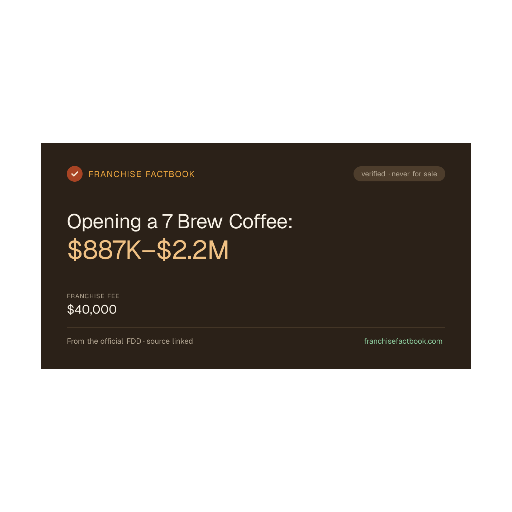
The first Store carries a $35,000 initial franchise fee, and each later Store under a Development Rights Rider carries a $25,000 initial franchise fee. The development fee is separate and nonrefundable, includes the first Store’s $35,000 fee plus $10,000 per additional committed Store, and requires at least a 10-Store commitment for new franchisees. The document also lists other upfront costs tied to opening and site setup, including optional extra opening support, the modular building, coffee equipment, and ground rent if the land is owned by the franchisor’s affiliate.
Read the FDD · PDF 15, 16 ↗Ongoing and other fees
The recurring fee schedule uses weekly Gross Sales to set the royalty in three tiers, with the royalty due every Friday after the calendar week ends. The Brand Fund contribution is currently 2% of weekly Gross Sales, but the franchisor says this is not a required local advertising spend and it does not require advertising cooperatives. The technology fee is currently 0.25% of weekly Gross Sales and funds system technology and related services. The schedule also includes transfer, training, audit, interest, management, indemnity, repair, and vendor pass-through charges, many of which are reimbursed at cost or as incurred.
Read the FDD · PDF 16, 17, 18, 19, 20, 21, 22, 23 ↗Estimated startup investment
The primary initial investment is for a new traditional 7 BREW Store with a minimum 10-store development commitment. The total estimated investment is $940,500 to $2,283,500, and the table separates the development fee, site/build-out, equipment, opening, and working-capital costs. The disclosure also says the estimate is for each Store established under the development rights rider.
Read the FDD · PDF 23, 24, 25, 26, 27, 28 ↗Suppliers and purchasing rules
You must follow Brand Standards for the Store and buy required operating assets, products, and services from 7 Brew, its affiliates, approved suppliers, or designated suppliers when required. 7 Brew can approve or reject suppliers, require samples or testing, inspect facilities, limit the number of approved sources, and later revoke approval. It also can earn revenue from supplier relationships and keep that revenue for itself and its affiliates.
Read the FDD · PDF 28, 29, 31, 32, 33 ↗Your contractual obligations
The disclosure table shows that the franchise agreement requires compliance with standards and policies, restrictions on products and services offered, ongoing product and service purchases, owner participation and staffing, insurance, advertising, records, inspections, transfer, renewal, non-compete obligations, dispute resolution, consumer data and data security, loyalty programs, and compliance with laws. These duties are tied to specific sections of the franchise and related agreements.
Read the FDD · PDF 34, 35 ↗Financing
The franchisor says it does not offer financing directly or indirectly for any part of the initial investment. the financing section separately describes an affiliate ground lease in limited situations, with monthly base rent, additional rent, late charges, owner personal guarantees, and no franchisor guarantee of notes, leases, or other obligations.
Read the FDD · PDF 36, 37 ↗Training and support
The franchisor provides initial training through virtual/distance learning and (at franchisor option) at a designated training location. Initial Training is split into three parts for ownership (2 days), store management (14 days), and hourly employees (3 days). Store managers must complete Initial Training and pass tests to be certified, and the store must have two fully trained managers on-site before opening; opening also depends on additional conditions beyond training. The FDD states Initial Training is provided at no additional fee, but the franchisee must pay employees’ wages/benefits and travel/hotel/food expenses while they attend training. For ongoing/supplemental training, the franchisor may require courses/programs but limits required attendance to no more than 3 consecutive days and no more than 5 total days per calendar year; you pay compensation and expenses. If special guidance/training is in addition to what the franchisor provides, you pay daily charges and travel/hotel/living expenses. An “opening team” is optional for the opening phase; Brand Fund is described as currently paying wages and travel-related expenses of any opening team, with franchisor not required to send one.
Read the FDD · PDF 38, 39, 40, 46, 47, 48, 49 ↗Territory rules
You may operate only at the site 7 Brew accepts, and you cannot relocate without prior written consent. For protected territory, 7 Brew gives you rights only to Traditional 7 Brew Stores within the defined protection area, but it expressly keeps broad rights to Non-Traditional stores and to competing or similar products, services, and channels. If you have development rights, the DRR gives you a defined Territory for Traditional stores only, but it is not exclusive and 7 Brew can still place or authorize Non-Traditional stores there and may delay development if it believes you are not ready.
Read the FDD · PDF 49, 50, 51, 52 ↗Brand names and trademarks
The parent owns the principal registered marks, and the franchisor licenses those marks for franchise use under the trademark license agreement. The FDD says the license runs 20 years initially, can be renewed for three successive 10-year terms, and may be terminated by the franchisor, including for uncured breach after notice. If the license ends, the franchisor and franchisor-related users must stop using and sublicensing the marks, while an authorized franchisee may continue only through the term of its franchise rights if it stays in compliance. The FDD says there are no current material adverse trademark determinations or pending infringement, opposition, cancellation, or material litigation involving the principal marks. It also says the franchisee must follow brand standards, cannot use marks in unauthorized ways, must report infringements or challenges, and may have to switch marks without reimbursement for related costs.
Read the FDD · PDF 53, 54, 55 ↗Other intellectual property
The FDD says no patents or patent applications are material to the franchise. It says the franchisor and affiliates claim copyrights in the Operations Manual, store designs, signage, marketing materials, the system website, and similar materials, but have not registered those copyrights. The franchisee may use copyrighted items only as permitted and must stop using them if directed. There are no effective adverse material determinations regarding those copyrights, and the franchisor says it does not know of infringing uses that could materially affect the franchise. The Operations Manual and related materials contain confidential information and trade secrets, including operating methods, systems, customer data, digital platform information, and certain financial and operating information. The franchisee must protect consumer data, report data incidents immediately, use reasonable safeguards, and sign over innovations created for the store, which the FDD says belong to the franchisor as works made for hire or by assignment.
Read the FDD · PDF 55, 56 ↗Owner involvement
You must designate one individual owner as Managing Owner, and 7 Brew must pre-approve that person. The Managing Owner communicates directly with 7 Brew and must have authority to make binding business decisions, but the agreement does not require that person to attend initial training. The Store must have at least two fully trained on-site managers, and a manager does not need an ownership interest. That staffing requirement does not turn the business into a semi-absentee model. Owners with at least 25% interests generally must personally guarantee the franchise obligations, while smaller owners must sign non-monetary undertakings tied to the agreement.
Read the FDD · PDF 57, 58 ↗What you may sell
The Store may sell only products and services 7 Brew authorizes, and 7 Brew can change the required or permitted product mix at any time. You may sell only at the Store location, not through wholesale, delivery, or other unapproved channels. 7 Brew also may control customer communication channels and may impose minimum days and hours of operation, including seven-day operation in some cases.
Read the FDD · PDF 58 ↗Renewal, exit, and disputes
The franchise term starts when the agreement is signed and runs 15 years from opening. If you are in good standing, you may be eligible for two successor franchises of 5 years each, on then-current terms, if you satisfy the listed notice, compliance, remodeling, and fee requirements. The franchisor says it does not have a right to terminate without cause, but it may terminate for stated curable and non-curable defaults. The FDD lists many franchisee defaults, including payment and reporting failures, failure to open by deadline, abandonment, unauthorized transfer, misuse of confidential information, certain legal violations, and data-security or consumer-data failures. After termination or nonrenewal, the franchisee must de-identify the store, return or destroy branded and proprietary materials, and stop using digital marketing and social media tied to the brand. Transfers require prior written consent, and the franchisor may impose conditions, use a right of first refusal, and require a release, training, repairs, and current-form documents. The agreement also includes non-compete restrictions during the term and for two years after expiration or termination, arbitration, forum, and Arkansas choice-of-law provisions. The ground lease has its own 15-year term, optional renewal rights if in good standing, landlord consent rights, and separate default and transfer rules.
Read the FDD · PDF 59, 60, 61, 62, 63, 64, 65, 66, 67 ↗Public figures
The franchisor states it does not use public figures to promote the franchise.
Read the FDD · PDF 67 ↗Reported financial results
7 BREW reports Fiscal Year 2025 annual Total Sales for stores that were open and operating for the full year. It gives one combined store group, one franchised-only group, and one company-owned group. The reported figures are per location, not per business or territory. The document also says the averages do not show costs or profit.
Read the FDD · PDF 68, 69, 70 ↗Franchise locations and changes
Franchised outlets expanded sharply each year, ending at 161 in 2023, 297 in 2024, and 578 in 2025. Company-owned outlets ended at 19, 24, and 24. Openings drove most of the growth, while terminations and non-renewals were zero in all three years. Transfers to new owners rose from 1 in 2023 to 14 in 2024 and 28 in 2025. The 2025 total outlet count excludes 2 non-traditional stores that did not have at least one drive-thru window.
Read the FDD · PDF 71, 72, 73, 74, 75, 76, 77, 78, 81, 82, 83 ↗Franchisor financial statements
The FDD includes Exhibit C with audited financial statements for the years ended December 28, 2025, December 29, 2024, and December 31, 2023, plus an unaudited balance sheet as of March 22, 2026 and an unaudited income statement for the fiscal period beginning December 29, 2025 and ending March 22, 2026.
Read the FDD · PDF 83 ↗Agreements you may sign
The FDD lists the exhibit contracts and documents: the Franchise Agreement and Amendment, Development Rights Rider, state-specific riders, sample general release, franchisee representations, Manufacturing Agreement, and Ground Lease.
Read the FDD · PDF 83 ↗Document receipt
The FDD says the franchisor’s and franchisee’s copies of the receipt are located at the last 2 pages of the disclosure document.
Read the FDD · PDF 83 ↗