

Hissho Sushi
Operate a full-service sushi bar system
Hissho International, LLC offers franchisees the right to operate a Full Service Sushi Bar, a Satellite Sushi Bar program (via delivery), or an Asian Food Bar under its system and branded names. Franchisees must operate under a franchise agreement at a Retail Host location.
Free Independent Franchise Consultant follow-up within 24 hours.
No revenue or sales performance tables were provided in the supplied the reported financial results section pages, so there are no disclosed cohorts, medians, means, or supporting gross-sales tables to extract from this record.
Explore details ↓The franchise is meant to be actively supervised: an Operating Principal must devote full time and best efforts to the business, and each unit must have direct on-premises management.
Explore details ↓What owning this franchise involves
You operate a food retail unit inside a Retail Host (such as grocery stores, supermarkets, hospitals, universities, or other third-party locations). The franchise involves complying with Retail Host requirements (including potential maximum/minimum pricing and any minimum performance rules the Retail Host sets). Each Full Service Sushi Bar and Asian Food Bar must have at least one ServSafe® certified person on duty at all times, and an Operating Principal must maintain required food-safety certification.
Business model · PDF 10, 11, 12, 13, 14, 15, 16, 17, 18, 66 ↗What you’d be running
The franchise is meant to be actively supervised: an Operating Principal must devote full time and best efforts to the business, and each unit must have direct on-premises management.
Owner responsibilities & training
You must send your Operating Principal and all equity owners (Operating Principal and any other equity owners) to complete the required Initial Training Programs at the franchisor’s headquarters in Rock Hill, South Carolina before opening. The required Initial Training is separate for a “Sushi Bar” and an “Asian Food Bar,” and the programs include both classroom and on-the-job training. The franchisor estimates each program is about 10 days in duration; taking both together may total about 15 days (with possible extensions up to 20 days for trainees without sufficient experience). Initial Training fees are $2,000 per Principal Trainee, plus $1,000 if a Helper attends (or a discounted combined rate if both Initial Training Programs are taken at the same time). If the Principal Trainee does not successfully complete within 60 days of signing the Franchise Agreement (as determined by the franchisor), the franchisor may terminate the Franchise and will not refund Initial Training Fees. If training is required beyond what is included, you pay additional fees as described, including One-on-One Training option fees ($3,500 in-person or $1,500 virtual/electronic) and possible additional Sushi Chef Training (10–20 days, fee plus travel/food/lodging). Before Initial Training, you or your Operating Principal must also hold a current ServSafe Food Protection Manager certification (plus any additional local/State food safety certifications required by your municipality). The franchisor states the Initial Training Fee/One-on-One fee/Sushi Chef Training fee include instructor and training materials, but you are responsible for other expenses for training, including transportation, lodging, and meals. The franchisor provides estimates for travel costs (e.g., about $1,500 to attend just one Initial Training Program for one Primary Trainee, and about $5,000 for one Primary Trainee and one Helper to attend both Initial Training Programs at separate times; plus about $1,500 for one equity owner to attend Sushi Chef Training). The franchisor also requires ongoing training and states it will provide training programs it deems appropriate throughout the year; these training requirements apply to the Operating Principal and other equity owners.
The business must operate from an approved location, usually inside a retail host or grocery setting. You do not receive an exclusive territory. Hissho can require approved or designated suppliers for most products and services, and it can approve or reject alternative suppliers in its sole discretion. The franchise is meant to be actively supervised: an Operating Principal must devote full time and best efforts to the business, and each unit must have direct on-premises management. A manager is required, but that alone does not make the business semi-absentee. You may sell only approved system items and services, use the premises only for the franchise, and comply with written standards. If the host location rights end or are limited, your right to operate there can end or be limited too. The owner entity must appoint an Operating Principal who devotes full time and best efforts to supervising and conducting the business, completes initial training, and signs the required guaranty. Each unit must have direct on-premises supervision by a manager, with enough competent staff to operate properly. Owners and the Operating Principal must sign confidentiality and non-competition agreements, and all personnel with access to confidential information must sign nondisclosure agreements. The franchisee must buy required products and services from Hissho-designated or approved suppliers, seek approval before using alternatives, and stop selling disapproved items or using disapproved suppliers. The franchisee must sell only system products and services, use the premises only for the franchise, and keep the unit open and operating during required hours. The franchisee may not relocate without prior written approval.
Read the FDD · PDF 36, 37, 38, 39, 40, 41, 43, 44, 50, 51, 52, 53, 55, 56, 60, 61, 62 ↗What it costs to open and operate.
The startup range is your opening estimate. The fee schedule shows the charges and conditions that continue after opening.
Includes an additional $0 to $150,000 if you purchase an existing food retail unit; initial working capital covers the first 3 months.
Explore my investment budget ↗View all 57 fees & conditions
| Fee | Amount / basis | When due | Notes |
|---|---|---|---|
| Initial franchise fee | $7,500 for a Full Service Sushi Bar or Asian Food Bar; $0 for a Satellite Sushi Bar. For additional Food Retail Units after the first, fee depends on months remaining on the first Franchise Agreement: $7,500 if 25 to 36 months remain, $3,750 if 13 to 24 months remain, and $1,875 if less than 13 months remain. For acquired existing units, the franchisor may require either a prorated fee for the remaining term or a full initial franchise fee with a new 3-year term. | Upon execution of the Franchise Agreement for a Food Retail Unit; for additional units, on the effective date of the addendum; for acquired existing units, at the franchisor’s option | Fully earned and non-refundable. Initial franchise fee collected in the last fiscal year ranged from $0 to $7,500. |
| Initial training fee | $2,000 per Primary Trainee for each Initial Training Program if taken separately, or $3,000 per Primary Trainee if the Initial Training Programs are taken at the same time; $1,000 per Helper for each program if taken separately, or $1,500 per Helper if taken at the same time. Example range given: $2,000 to $6,000 for one Primary Trainee attending one program versus one Primary Trainee plus a Helper attending both programs at separate times. | Before or during required initial training, as billed | Excludes travel, lodging, and meals. Applies to the Sushi Bar and Asian Food Bar initial training programs. |
| One-on-one training fee | $3,500 for in-person one-on-one training; $1,500 for virtual one-on-one training; $0 if no one-on-one training is needed or offered. | If one-on-one training is offered and completed, as charged | Applies only if a Primary Trainee does not successfully complete the initial training but is allowed one final additional session. A Helper may attend virtual one-on-one training at no extra cost. |
| Sushi chef training fee | $2,000 per equity owner who lacks sufficient sushi chef experience; $0 if no equity owner needs the training. | When additional sushi chef training is required | Training lasts 10 to 20 days at a location designated by the franchisor. |
| Equipment and small wares | Estimated initial cost of $1,000 to $15,000 per Full Service Sushi Bar, plus up to $2,000 for each Satellite Sushi Bar opened at the same time; for an Asian Food Bar, $1,000 to $25,000. With a Satellite Sushi Bar opened alongside a Full Service Sushi Bar, the estimate is $1,000 to $17,000 for the Full Service Sushi Bar. | Before opening, as purchased | Items are purchased from the franchisor, Lwin, or an approved third-party drop ship vendor. Amounts paid to the franchisor or Lwin are non-refundable. May be financed in part. |
| Sushi robot | $10,400 to $15,000 if required for a high-volume location | When required by the franchisor | Non-refundable. Pricing varies by distributor and robot specifications. |
| Hissho label system initial lease fee | $1,500 per Hissho Label System | Before gaining access to the Hissho Label System | Non-refundable lease fee for use of the system. |
| Tablet setup fee | $50 per full-service Food Retail Unit, may increase to $150 maximum per full-service Food Retail Unit | On the first statement following tablet delivery | One-time fee. The tablet may be delivered before or after opening. Non-refundable. |
| Food inventory and supply purchases | $5,000 to $25,000 per Full Service Sushi Bar or Asian Food Bar; plus $1,000 to $6,000 for a Satellite Sushi Bar opened at the same time. Estimated total: $5,000 to $31,000 for a Full Service Sushi Bar if a Satellite Sushi Bar is opened simultaneously; $5,000 to $25,000 for an Asian Food Bar. | Before opening | Estimated to cover opening and one month of operations for a Full Service Sushi Bar or Asian Food Bar, and three months for a Satellite Sushi Bar. You may not open a Satellite Sushi Bar without a Full Service Sushi Bar. |
| Uniforms | Approximately $140 for two sets for the Operating Principal; approximately $140 per additional employee for two sets | Before opening, as purchased | Must be purchased from affiliate Lwin. |
| Insurance | Estimated first-year business insurance policy cost of $500 to $5,000 | Before opening; then annually on an ongoing basis | The franchisor obtains the initial first-year policy on your behalf and adds the cost to your first statement. Annual insurance remains your responsibility. |
| Manuals | $300 total for one copy of the Confidential Franchise Manual and one copy of the SSOP/HACCP Food Safety Plan Book | As purchased | Where reasonably possible, the Food Safety Plan Book may be provided digitally. |
| Point-of-sale and other marketing materials | $300 to $2,000 per Food Retail Unit before opening | Before opening | Materials and related services are created and billed as provided; service costs are deducted from Franchise Commissions. |
| Initial background check, credit check, and drug test fee | $200 per owner or shareholder/member | After application approval, when consent is given | Non-refundable. There is no application fee. |
| Local and state business license fees and permits | $100 to $6,000 estimated for initial licenses and permits, excluding business entity formation; plus $100 convenience fee per license/permit when the franchisor obtains or renews them for you | Before opening; then as licenses/permits are obtained or renewed | Costs vary by location. Non-refundable. |
| Compensation to franchisor | Typically 0% to 20% of Gross Sales retained by the franchisor after deductions; the Retail Host typically retains 27% of Gross Sales, but the service commission may vary widely from 0% to 40% of Gross Sales depending on location and host. | Monthly statement for the prior month | This is the franchisor’s share of Gross Sales after the Retail Host’s service commission. The franchisor may reduce its franchise commission if the Retail Host’s share increases. |
| Brand fund contribution | Up to 2% of Net Sales | Weekly, in the same manner as other fees | The franchisor may increase the contribution up to the 2% maximum on 30 days’ written notice. |
| Ongoing food purchases, supplies, and condiments | Varies depending on sales volume | Monthly statement | May be deducted directly from Franchise Commissions. Purchases from Lwin and approved drop-ship vendors are non-refundable. |
| Ordering non-compliance fee | Difference between the amount the unit should have ordered based on sales volume and the actual supply order placed through the affiliate | Payable on demand | Designed to prevent purchases from unapproved sources. May be deducted from Franchise Commissions. |
| Annual point-of-sale marketing material fees | Up to $4,000 per year per Food Retail Unit | On demand | Annual materials are provided during each year of operation to promote the unit and brand. May be deducted from Franchise Commissions. |
| Transfer fee | $2,500 per transferred Food Retail Unit | Before transfer approval | May be deducted from Franchise Commissions. Applies to transfers of a Food Retail Unit. |
| Renewal fee | 100% of the franchisor’s then-current franchise fee at renewal; or 12.5%, 25%, or 50% of the then-current franchise fee depending on average weekly sales and other requirements | Upon signing the renewal of the Franchise Agreement | May be deducted from Franchise Commissions. |
| Lab test to examine food | $2,000 per food item test | On demand | Used for food safety testing, usually at the franchisor’s discretion. |
| Request for approval of new product, supplier, or vendor | $500 per request plus out-of-pocket investigation expenses; the $500 is not charged if the new vendor is approved | On demand | If the franchisor accepts the new vendor, supplier, or manufacturer as approved, the $500 is returned. |
| Annual recurring loan fee for SSOP/HACCP Food Safety Plan Book | $150 per year per Food Retail Unit type, excluding delivery locations | On demand | Applies to each Food Retail Unit type franchised. The book is loaned, remains the franchisor’s property, and must be returned at expiration or termination. |
| Annual and/or renewal local and state business license and permit fees | $100 to $6,000 per year | On demand | If the franchisor obtains or maintains them, you reimburse the costs and fees plus the convenience fee. Annual renewal amounts are estimated at $100 to $1,000 in the notes. |
| Convenience fee to obtain and/or renew state and local licenses and permits/resale certificates | $100 per license | On demand | Applies when the franchisor obtains or renews licenses, permits, or resale certificates. |
| Third-party inspection fee | $100 per inspection conducted by a designated third party | On demand | Charged each time a designated third party conducts an inspection, whether the unit passes or fails. |
| Non-compliance fee | Up to $500 per incident | On demand | May also be charged for repeated insurance failures, in addition to insurance costs and the insurance service fee if the franchisor must obtain coverage. |
| Special on-site support fee | $500 per day, plus travel costs | On demand after an on-site visit or training | Used when on-site assistance is needed. |
| Additional training session fee | $200 per trainee per day | On demand after training is provided | Applies to additional training sessions; the Operating Principal and other equity owners are required to attend. |
| Failure to attend mandatory, additional, and ongoing training session fee | $250 per trainee per day | On demand | Charged when required training is missed after operations begin. |
| Additional mandatory training for default | $500 per trainee per day, plus the franchisor representative’s travel, food, and lodging costs | On demand | Applies after a default notice if the operating default is not cured in time. |
| Administration/web fee | $100 per monthly statement, may increase to $250 maximum per monthly statement | Monthly statement | Covers website, web services, email system, and the @hsfran.com email address. |
| Recurring background check fee | Actual cost of each member of personnel’s background check | If required by the Retail Host, currently once every 15 months | Applies after the first year of operations when required by the Retail Host. This is separate from the initial owner background check fee. |
| Interest on unpaid or past due amounts owed | 8% annual interest or the highest rate permitted by law | On demand | May be deducted from Franchise Commissions. |
| Food Retail Unit drop fee | $2,500 per Food Retail Unit discontinued by you with approval | Upon approval to discontinue operations | You do not have the right to discontinue operations without approval. |
| Early termination fee | $5,000 per Food Retail Unit terminated early because of your default | On demand | May also be accompanied by damages, including travel, labor, employee costs, food products removed or unpaid, and other operating expenses. |
| Sampling services fee | $0 to $180 per day | On demand when service is provided | Used when required food sampling is not provided and the franchisor or contractors perform the sampling work. Can include hourly costs plus $3 per hour per person when employees or contractors provide the service. |
| Transfer to new entity fee | $250 | Upon your request to transfer | Applies to a transfer to a new entity at your request. |
| Garnishment/levy fee | $100 for each receipt of notice of garnishment or levy | On demand | Charged for each notice received. |
| Insurance | $500 to $5,000 per year, but may be higher depending on individual professional circumstances | On demand | The franchisor obtains the initial first-year policy on your behalf and adds the cost to your first statement; annual insurance remains your responsibility. |
| Insurance service fee | $100, plus the cost of insurance | On demand | Charged if the franchisor obtains insurance for you after a coverage lapse; may also trigger a non-compliance fee. |
| Express handling fee | $200 | On demand | Charged if inventory and supplies are not ordered by the required deadline. |
| Technology fee | $150 per Food Retail Unit per monthly statement, may increase to $300 maximum per monthly statement | Per monthly statement | Used for technology development, maintenance, usage, and related third-party technology fees. This is the recurring technology charge. |
| Data overage fee | $10 per 1GB based on current market rate for data | On demand | Applies when wireless data usage for the Hissho Label System exceeds the monthly allotted 100mb. |
| Hissho Label System replacement fee | $1,000 per lost or damaged piece of equipment | On demand | Applies to lost or damaged equipment. |
| Hissho Label System non-return fee | $1,500 per Hissho Label System if the equipment and/or software are not returned at expiration or termination | On demand | Applies if the system is not returned when the agreement ends. |
| Tablet setup fee | $50 per full-service Food Retail Unit, may increase to $150 maximum per full-service Food Retail Unit | Billed on the next monthly statement following tablet delivery | One-time fee for device configuration and delivery. |
| Digital logbook fee | $50 per Food Retail Unit, may increase to $100 maximum per Food Retail Unit | Every six months, billed to the corresponding statement | Recurring biannual fee. A franchisee who assumes an existing unit is not charged until the end of the prior franchisee’s six-month billing cycle. |
| Replacement tablet fee | $250, may increase to $350 maximum | Billed on the next monthly statement following tablet delivery | Charged for loss, theft, or damage to tablet equipment, and includes a replacement tablet. |
| Tablet non-return fee | $350 per tablet if not returned at expiration or termination | On demand | Charged if the tablet is not returned when the agreement ends. |
| Replacement case fee | $40, may increase to $55 maximum | Billed on the next monthly statement following tablet delivery | Charged if the protective tablet case must be replaced and the tablet is undamaged. |
| Case non-return fee | $55 per case if not returned at expiration or termination | On demand | Charged if the tablet case is not returned when the agreement ends. |
| Negotiated retail price increase fee | The percentage designated by the franchisor of the additional Net Sales generated by a negotiated retail price increase | Amounts retained before payment of Franchise Commissions | Applies to additional Net Sales generated from a negotiated retail price increase between you and the Retail Host. |
| Food invoice and handling fee | 6% of the amount of each applicable invoice | Upon payment of the applicable invoice | Applies if you do not purchase food products from the franchisor or its affiliates. |
| Cooperative advertising programs | As the Cooperative determines | As the Cooperative directs | If a Cooperative is formed for your region, membership is mandatory and contributions are in addition to other required marketing expenditures. |
All fees are uniform and nonrefundable unless a note says otherwise.
The ongoing and other fees section amounts are usually deducted from Franchise Commissions.
Monthly statements are issued every four weeks, not once per calendar month.
Gross Sales excludes sales taxes and other taxes collected for remittance.
The Retail Host’s retained share of Gross Sales is negotiated and may change during the term.
Brand Fund contributions can be increased only up to the stated maximum on 30 days’ written notice.
initial fee schedule
| Fee | Amount | Due date | Notes |
|---|---|---|---|
| Initial franchise fee | $7,500 for Full Service Sushi Bar or Asian Food Bar; $0 for Satellite Sushi Bar; additional units after the first depend on months remaining: $7,500, $3,750, or $1,875 | Upon execution / addendum / at franchisor option for existing units | Fully earned and non-refundable; collected last fiscal year ranged $0 to $7,500 |
| Initial training fee | $2,000 per Primary Trainee per program if separate; $3,000 per Primary Trainee if taken together; $1,000 per Helper per program if separate; $1,500 per Helper if taken together | During required training | Excludes travel, lodging, and meals |
| One-on-one training fee | $3,500 in-person; $1,500 virtual; $0 if not needed/offered | If offered and completed | Only if the trainee needs an additional session |
| Sushi chef training fee | $2,000 per equity owner needing training | When required | 10 to 20 days of training |
| Equipment and small wares | $1,000 to $15,000 per Full Service Sushi Bar, plus up to $2,000 per Satellite Sushi Bar opened at same time; $1,000 to $25,000 per Asian Food Bar | Before opening | Non-refundable if paid to franchisor or Lwin |
| Food inventory and supply purchases | $5,000 to $25,000 per unit, plus $1,000 to $6,000 for simultaneous Satellite Sushi Bar | Before opening | Estimated to cover opening and first month/three months depending on unit type |
| Background check, credit check, and drug test fee | $200 per owner or shareholder/member | After application approval and consent | Non-refundable |
| Local and state business license fees and permits | $100 to $6,000, plus $100 convenience fee per license/permit when obtained by franchisor | Before opening and upon renewal | Non-refundable |
Where Your Startup Money Goes
| Cost | Disclosed amount | Payment timing | Payee |
|---|---|---|---|
| Initial Franchise Fee | $7,500 | At signing of Franchise Agreement | Us |
| Insurance | $500 to $5,000 | As incurred | Us & insurance carrier |
| Initial Training Programs | $3,500 to $11,000 | Prior to training and during training | Us and suppliers of food and lodging |
| Sushi Chef Training | $0 to $3,500 | Prior to training and during training | Us and suppliers of food and lodging |
| One-on-One Training | $0 to $5,000 | Prior to training | Us and suppliers of food and lodging |
| ServSafe® Food Protection Manager Certification | $99 to $199 | Prior to training | Third parties |
| Professional Advisors | $1,000 to $5,000 | As incurred | Attorneys, accountants, 3rd party service providers, and other professional advisors |
| Point-of-Sale and Other Marketing Materials | $300 to $2,000 | When delivered to you | Us, Lwin, or suppliers of materials |
| Initial equipment & small wares | $1,000 to $25,000 | As incurred | Lwin and approved suppliers |
| Sushi robot | $0 to $15,000 | As incurred | Lwin and approved suppliers |
| Hissho Label System Terminal | $1,500 | As incurred | Lwin and approved suppliers |
| Tablet Setup Fee | $50 | As incurred | Us, Lwin or approved suppliers |
| Digital Logbook Fee | $100 | As incurred | Us, Lwin or approved suppliers |
| Initial food inventory and supply purchases | $5,000 to $31,000 | As incurred | Lwin |
| Uniforms | $140 to $280 | As incurred | Lwin |
| Local and State Business License Fees and Permits | $100 to $6,000 | As incurred | Us |
| Confidential Franchise Manual Loan Deposit Fee & Initial Loan Deposit SSOP/HACCP Food Safety Plan Book Fee | $300 | When delivered to you | Lwin |
| Initial Background Check, Credit Check, and Drug Test | $200 | In advance as incurred | Us |
| Computer (hardware & software) | $500 to $800 | As incurred | Third parties |
| Additional funds (3 months initial phase) | $5,000 to $25,000 | As incurred | N/A |
| Existing food retail unit purchase premium | $0 to $150,000 | If you purchase an existing food retail unit | Our affiliate or another seller |
The stated total excludes an additional $0 to $150,000 if you purchase an existing food retail unit.
The initial investment table includes amounts paid to the franchisor or its affiliate Lwin as part of the total.
Satellite Sushi Bar is not a standalone startup format; it is an add-on cost that may be opened only with a Full Service Sushi Bar.
Digital Logbook Fee is recurring biannual; the table shows one six-month installment, which may be the maximum payable during the initial three-month period.
Insurance amounts are estimated annual costs for a single Food Retail Unit.
The initial food inventory estimate can include up to three months of operation for a Satellite Sushi Bar.
Amounts paid to us or our affiliate Lwin are non-refundable; amounts paid to other suppliers are typically non-refundable.
Read the FDD · PDF 31, 32, 33, 34, 35, 36, 41, 42, 43 ↗Franchisor financing
The franchisor does not offer direct or indirect financing except for optional, discretionary arrangements. It may advance loan funds of $1,000 to $2,500 for up to 3 months after opening, finance part of initial food inventory up to $25,000 for up to 6 months, and allow deferred payment of up to $25,000 of initial equipment and small wares for up to 6 months, or up to 12 months for a sushi robot. Lwin may also extend month-to-month credit for ongoing purchases. The franchisor does not guarantee your note, lease, or obligations, but it and Lwin may withhold amounts from Franchise Commissions and may require shareholder/member guarantees and promissory notes in some cases.
No direct or indirect financing except as described.
Loan Advance: up to $1,000-$2,500; 3 months; no APR stated; discretionary.
Food Inventory and Point-of-Sale Materials Purchase: up to $25,000; 2-6 months; no APR stated; discretionary.
Equipment and Small Wares: up to $25,000; 2-12 months; no APR stated; discretionary; sushi robot may extend to 12 months.
No down payment stated for the listed financing programs.
The franchisor does not guarantee your note, lease, or obligations.
Franchise Agreement must be signed and joined by each shareholder/member, and obligations must be guaranteed by each shareholder/member signing the guaranty.
Lwin may extend month-to-month credit for ongoing purchases; amounts may be withheld from Franchise Commissions.
If a promissory note is required and default occurs, interest may accrue at South Carolina maximum lawful rate; otherwise default is treated as a monetary default under the Franchise Agreement.
Read the FDD · PDF 41, 42, 43 ↗See the results. Know what to ask next.
An independent franchise consultant can help you understand the reporting group, what the figures include, and the questions to take to current owners.
Put These Numbers in Perspective ↗Read the disclosed scope and limitations
No revenue or sales performance tables were provided in the supplied the reported financial results section pages, so there are no disclosed cohorts, medians, means, or supporting gross-sales tables to extract from this record.
Revenue is not profit or owner income.
What the FDD says
The supplied pages include only the the reported financial results section introductory disclosure and do not include any the reported financial results section performance tables or notes.
Read the FDD · PDF 66 ↗Explore the reported measures and limitations
No the reported financial results section performance figures, cohort breakdowns, or supporting tables were provided in the source pages supplied for review.
Get a second opinion on Hissho Sushi.
Get a clearer picture of Hissho Sushi with an independent franchise consultant. Know what to ask, what to check, and how to take the next step with confidence.
- Get help checking territory availability
- Prepare questions for the franchisor and current owners
- Know what to investigate before you sign
A look at the footprint.
The system ended 2025 with 2,750 total outlets, up from 2,442 in 2024 and 2,311 in 2023. Franchised outlets ended at 2,614 in 2025, while company-operated outlets ended at 136. The franchise outlet table shows the 2025 increase came from 435 openings, 123 terminations, no non-renewals, 80 franchisor reacquisitions, and no ceasing for other reasons. The company-operated outlet table shows 97 openings, 80 reacquisitions from franchisees, 23 closures, and 78 sales back to franchisees in 2025. Table 2 reports outlet transfers by state, with California, North Carolina, Pennsylvania, and Texas among the larger transfer states in 2025.
Where would you build?
No exclusive territory is granted. Hissho and its affiliates may operate or license other units, sell similar products through other channels, and customers from outside the assigned area may order from your unit. The unit must operate at the specific approved location in the Franchise Agreement. If the retail host agreement ends, is limited, or its performance conditions are not met, your right to operate there can also end or be limited. Hissho may offer a Satellite Sushi Bar opportunity nearby, but that is discretionary and documented by addendum, not a territory right.
Explore FDD-listed operators ↓Explore outlet tables and changes
Systemwide outlet summary
| Outlet type | 2023 start | 2023 end | 2023 net change | 2024 start | 2024 end | 2024 net change | 2025 start | 2025 end | 2025 net change |
|---|---|---|---|---|---|---|---|---|---|
| Franchisee owned units | 2057 | 2194 | +137 | 2194 | 2382 | +188 | 2382 | 2614 | +232 |
| Company-operated | 74 | 117 | +43 | 117 | 60 | -57 | 60 | 136 | +76 |
| Total outlets | 2131 | 2311 | +180 | 2311 | 2442 | +131 | 2442 | 2750 | +308 |
Status of franchise outlets
| Year | Outlets at start | Opened | Terminations | Non-renewals | Reacquired by franchisor | Ceased other reasons | Outlets at end |
|---|---|---|---|---|---|---|---|
| 2023 | 2057 | 315 | 108 | 0 | 70 | 0 | 2194 |
| 2024 | 2194 | 343 | 114 | 0 | 41 | 0 | 2382 |
| 2025 | 2382 | 435 | 123 | 0 | 80 | 0 | 2614 |
Status of company-operated outlets
| Year | Outlets at start | Opened | Reacquired from franchisee | Closed | Sold to franchisee | Outlets at end |
|---|---|---|---|---|---|---|
| 2023 | 74 | 81 | 75 | 21 | 92 | 117 |
| 2024 | 117 | 103 | 41 | 30 | 171 | 60 |
| 2025 | 60 | 97 | 80 | 23 | 78 | 136 |
Transfers of outlets from franchisees to new owners (other than the franchisor)
| State | 2023 | 2024 | 2025 |
|---|---|---|---|
| AL | 0 | 3 | 2 |
| CA | 27 | 23 | 29 |
| CO | 13 | 11 | 18 |
| FL | 14 | 10 | 26 |
| GA | 7 | 17 | 11 |
| MA | 9 | 2 | 11 |
| MD | 16 | 28 | 21 |
| MI | 26 | 14 | 15 |
| NC | 10 | 20 | 12 |
| OH | 15 | 18 | 25 |
| PA | 28 | 25 | 19 |
| TX | 14 | 16 | 19 |
| VA | 13 | 25 | 20 |
| WI | 8 | 9 | 6 |
Physical page 67 contains the systemwide outlet summary for 2023 to 2025.
Physical pages 67-75 contain the state-by-state franchise outlet movement tables; totals are on page 75.
Physical pages 75-79 contain the state-by-state company-operated outlet movement tables; totals are on page 79.
Do not treat transfer counts or projected openings as outlet counts.
Do not treat territories as franchisees or physical shops.
See where Hissho Sushi operates.
2,614 active franchises nationwide · Year-end 2025
Hover over a state or tap it to see the count. Darker shading indicates more franchised outlets.
Select a state to see its franchised outlet count.
Read the FDD · PDF 71, 72, 73, 74, 75 ↗Take a closer look at Hissho Sushi.
You don’t have to figure it out alone. Talk with an independent franchise consultant about the ownership fit, territory questions, and your next steps.
Free to you. No obligation to buy or move forward.
An Independent Franchise Consultant will respond to your Hissho Sushi inquiry.
About Independent Franchise Consultants ↗Independent Franchise Consultants are independent of the brands discussed and may be compensated by participating franchisors if you purchase. They do not work with every brand.
Go deeper when you’re ready.
Explore the FDD sections
The business and its background
Hissho International, LLC is the franchisor that grants franchise rights to operate branded food retail units—Full Service Sushi Bars, Satellite Sushi Bars (delivery from a Full Service Sushi Bar), and Asian Food Bars—under the Hissho system at Retail Host locations. Franchisee ownership must be a legal entity (not an individual/sole proprietorship) and each owner must sign a guaranty. Food-safety requirements include having at least one ServSafe®-certified person on duty at all times.
Read the FDD · PDF 10, 12, 14 ↗Leadership experience
The FDD lists leadership and operational/business experience roles for multiple executives (including the CEO, COO, CFO, and others). The document provides service dates and locations for these individuals, which are part of the franchise disclosure’s “Business Experience” item.
Read the FDD · PDF 15 ↗Legal history
Hissho says no litigation information is required to be disclosed for this Item.
Read the FDD · PDF 18 ↗Bankruptcy history
Hissho says no bankruptcy information is required to be disclosed for this Item.
Read the FDD · PDF 18 ↗Upfront franchise fees
The brand charges a $7,500 initial franchise fee for a Full Service Sushi Bar or Asian Food Bar and no initial franchise fee for a Satellite Sushi Bar. Additional units can qualify for lower franchise fees based on remaining term, and acquired existing units may be charged either a prorated fee or a full fee with a new 3-year term. Startup costs also include required training, equipment, inventory, insurance, manuals, marketing materials, background checks, licenses, and several unit-specific setup items. Most of these initial fees are non-refundable, and several are payable before opening or when the related service is provided.
Read the FDD · PDF 18, 19, 20, 21 ↗Ongoing and other fees
The ongoing fee structure is driven by the retailer commission split, a weekly brand fund contribution up to 2% of Net Sales, recurring technology and statement charges, and a mix of event-based charges for transfers, training, inspections, non-compliance, insurance handling, and equipment or logbook replacements. Several fees can be deducted from Franchise Commissions, and the due dates often use the franchisor’s four-week statement cycle rather than a calendar month. The most important recurring charges for an owner are the franchisor’s compensation share, the brand fund contribution, and the technology fee, with additional marketing spending possible through annual point-of-sale materials and any Cooperative program the franchisor later forms.
Read the FDD · PDF 22, 23, 24, 25, 26, 27, 28, 29, 30, 31 ↗Estimated startup investment
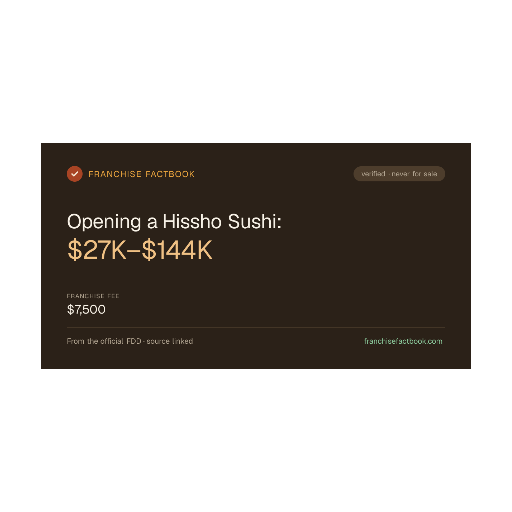
The initial investment for a Full Service Sushi Bar is $26,789 to $144,429, before any optional purchase of an existing food retail unit. The table covers the franchise fee, training, insurance, equipment, inventory, permits, setup fees, professional help, and three months of additional funds. Several items are paid to the franchisor, Lwin, or third parties. The largest swing comes from equipment, inventory, and any existing-unit premium.
Read the FDD · PDF 31, 32, 33, 34, 35, 36 ↗Suppliers and purchasing rules
Hissho can require franchisees to buy specified products, supplies, equipment, and services only from Hissho, its affiliates, or suppliers it chooses. For sushi products, Hissho says designated suppliers are required, and currently its affiliate Lwin is the main approved distributor. Alternative suppliers require a written approval process, possible inspections and testing, and Hissho may approve or reject them in its sole discretion. The unit must also be at an approved location, and lease terms may need Hissho’s written approval. If the host location rights end or are limited, the franchisee’s operating rights there end or are limited too.
Read the FDD · PDF 36, 37, 38, 39 ↗Your contractual obligations
The disclosure table ties site selection, purchases, operations, training, compliance with standards, product restrictions, and owner participation to the franchise agreement and related documents. For owner involvement and staffing, the table points to the franchise agreement sections that govern participation, management, and staffing. For product and service restrictions, it points to the sections governing what may be offered and purchased. This item is a roadmap to the obligations, not a separate substantive rule set.
Read the FDD · PDF 40, 41 ↗Financing
The franchisor says it does not offer direct or indirect financing except for discretionary advances and deferred payment arrangements. It may advance funds for opening cash needs, finance inventory, or defer some equipment and small-wares payments, and Lwin may extend ongoing trade credit. The franchisor does not guarantee the lease, note, or obligations, but shareholder/member guarantees may be required, and amounts can be withheld from Franchise Commissions.
Read the FDD · PDF 41, 42, 43 ↗Training and support
Before opening, the franchisor provides certain assistance (site/lease approval support as part of pre-opening obligations, Initial Training, the Operations Manual, advice/consultation, and delivery of required equipment/signage/fixtures/opening inventory and supplies in exchange for item-5 fee payments). The franchisor also describes its ongoing training and consultative support during operations, but it is explicit that it is not required to provide supervision/assistance beyond what is stated. Training attendance is required for your Operating Principal and other equity owners. Initial Training is offered for Sushi Bar and Asian Food Bar with estimated durations and a combined-program option; classroom instruction is shared while on-the-job parts differ. All Initial Training is conducted at the franchisor’s headquarters in Rock Hill, South Carolina, unless an optional One-on-One Training is provided virtually. Tuition/fees for training include instructors and training materials, while trainees must pay other expenses, including transportation, lodging, and meals; the franchisor provides estimates for these travel costs. Additionally, prior to Initial Training, you/your Operating Principal must complete ServSafe Food Protection Manager certification and may need additional state/local food safety certifications. The franchisor can also require additional Sushi Chef Training for equity owners lacking sufficient experience (10–20 days) at your cost, including travel/food/lodging.
Read the FDD · PDF 43, 44, 45, 50, 51 ↗Territory rules
No exclusive territory is granted. Hissho may place the business at a chosen or approved location, but the right to operate depends on the retail host arrangement. If Hissho’s or its affiliate’s rights to the location end or are limited, the franchisee’s right to operate there ends or is limited too, with no right to compensation or a replacement site. Hissho keeps the right to operate or license other units anywhere it wants, and it can sell similar products through other channels. The franchisee may not use alternate channels like e-commerce or telemarketing without written consent, but sales are not limited to customers inside the assigned area.
Read the FDD · PDF 55, 56 ↗Brand names and trademarks
Hissho says it owns its Proprietary Marks and licenses them for use only as authorized in the Franchise Agreement and only for the franchised Food Retail Units and approved advertising. The franchisee must not use the marks as part of a corporate or legal name. The disclosure lists several federally registered marks and several pending applications. Some principal marks are not federally registered, which means they do not have all of the legal benefits of federal registration and a challenge could require a change of marks and increase expenses. The license is non-exclusive, Hissho may license others and may modify or discontinue marks, and it says there are no known superior prior rights or material infringement proceedings disclosed.
Read the FDD · PDF 56, 57, 58, 59 ↗Other intellectual property
Hissho says it has no patents pending and does not claim material patent rights beyond what is disclosed. It claims copyright protection in its manual, advertising, specifications, training materials, food safety plan book, and certain forms and programs, even though not all copyright applications have been filed. The franchisee must use the manual and related materials only as authorized, keep them confidential, not copy or disclose them, and follow revised standards. The Item also requires strict protection of confidential information, including recipes, methods, procedures, and financial information, and limits disclosure to employees who need access for operations.
Read the FDD · PDF 59, 60 ↗Owner involvement
The franchisee entity must appoint an Operating Principal. That person must devote full time and best efforts to supervising and conducting the business, complete initial training, and sign the guaranty. A manager is also required for direct on-premises supervision, but the document separately requires the Operating Principal’s full-time involvement, so having a manager does not by itself make the business semi-absentee. Hissho places few limits on whom you may hire as manager, but owners and the Operating Principal must sign nondisclosure and non-competition agreements, and every owner must sign a guaranty.
Read the FDD · PDF 60, 61 ↗What you may sell
The franchisee must sell the system’s products and services and any future additions to the system, and may not use the marks for another business. The unit must be used only for the franchise, stay open during required hours, and be operated under the franchisor’s written standards. Only approved items, condiments, products, and services may be sold, including chef specials that follow approved ratios and ingredients. Hissho can disapprove items in writing, and the franchisee must stop selling them. The franchisee must also follow Hissho’s purchasing standards and use only conforming supplies and packaging.
Read the FDD · PDF 61 ↗Renewal, exit, and disputes
The franchise term is three years or earlier if Hissho’s or its affiliate’s right to operate at the location ends, and there is one additional three-year renewal term if the renewal conditions are met. Renewal can require advance notice, renovation to current standards, full compliance, payment of outstanding amounts, continued possession rights at the site, execution of the then-current franchise agreement and release, and completion of current training and qualification requirements. Hissho may terminate for defaults, and some defaults are listed as curable in 15 days while others are non-curable, including bankruptcy, unauthorized transfer, disclosure of confidential information, false records, unauthorized mark use, abandonment, and certain lease or operating violations. On termination or non-renewal, the franchisee must stop operating, stop using the marks and trade dress, de-identify, return materials and equipment, pay amounts due, and may have to leave furniture, fixtures, signs, and equipment behind. Transfers require Hissho approval, may trigger conditions, a transfer fee of $2,500 per unit, and possibly a new agreement or new term. The agreement also allows Hissho to match offers, purchase interests in some situations, and take over if a controlling owner dies or becomes disabled and the transfer is not completed. The non-compete provisions restrict operating or being involved in competing sushi businesses during the term and for one year after termination or expiration, within 20 miles of the unit. Disputes are subject to arbitration in Charlotte, North Carolina, and South Carolina law applies, with some state-law exceptions.
Read the FDD · PDF 62, 63, 64, 65, 66 ↗Public figures
The franchisor states that it does not use any public figure to promote the system.
Read the FDD · PDF 66 ↗Reported financial results
No revenue or sales performance tables were provided in the supplied the reported financial results section pages, so there are no disclosed cohorts, medians, means, or supporting gross-sales tables to extract from this record.
Read the FDD · PDF 66 ↗Franchise locations and changes
The system grew from 2,311 total outlets at the end of 2023 to 2,442 at the end of 2024 and 2,750 at the end of 2025. Franchised outlets accounted for most of the growth, ending 2025 at 2,614. Company-operated outlets ended 2025 at 136, after dropping to 60 in 2024 and then rising again in 2025. The franchise outlet movement table shows 2025 growth came from more openings than terminations and reacquisitions. The company-operated table shows significant internal movement between company and franchise ownership, including openings, reacquisitions, closures, and sales to franchisees. The transfer table lists state-level transfers of outlets to new owners, with California, North Carolina, Pennsylvania, and Ohio among the larger states by transfer count in 2025.
Read the FDD · PDF 67, 75, 79 ↗Franchisor financial statements
The franchisor states that Exhibit D contains audited financial statements for the fiscal years ended December 31, 2025, December 31, 2024, and December 31, 2023. The supplied excerpt does not include the underlying financial statements, the audit report, or any going-concern disclosure, so those details are not available here.
Read the FDD · PDF 81 ↗Agreements you may sign
The disclosure says these required agreements and exhibits are attached: the Franchise Agreement and related attachments, the Training and Confidentiality Agreement, the Franchisee Owners exhibit, and the Promissory Note.
Read the FDD · PDF 81 ↗Document receipt
The final two pages are detachable receipt pages acknowledging delivery of the disclosure document. If those pages or any other pages or exhibits are missing, the franchisee is instructed to notify the franchisor immediately.
Read the FDD · PDF 81 ↗