
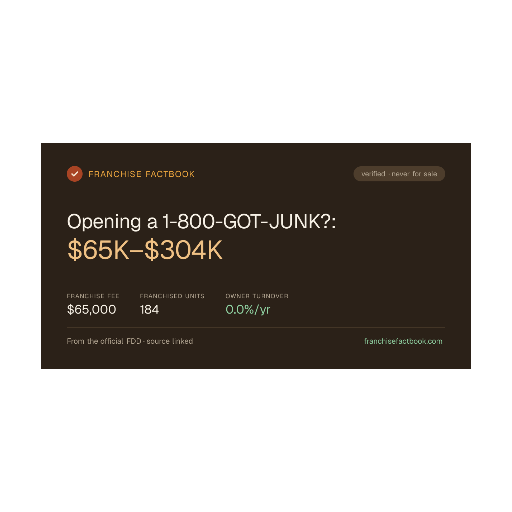
1-800-GOT-JUNK?
1-800-GOT-JUNK? LLC, a Delaware limited liability company, franchises U.S. businesses that remove and haul non-hazardous junk for disposal, reuse, or recycling. The brand says these businesses serve homeowners, property managers, contractors, realtors, and other businesses. The franchisor says it has no other business activities and has not operated a business of this type.
What It Costs
Open The Full FDDThe disclosed estimate has specific assumptions. Review the included costs and conditions below.
Key Franchise Fees
- Initial Franchise Fee
- $8,125 Per Subterritory · Eight Minimum
View Disclosed Terms
$8,125 Per Subterritory · Eight Minimum
What To Know
The stated fee is per subterritory; the minimum new territory offered is 8 subterritories. Each additional subterritory beyond 12 is also $8,125.
The fee is due in a lump sum at signing. The agreement schedule sets the fee and due dates for the particular subterritories; a subterritory cannot be serviced until its fee is paid in full and its activation date has arrived. The franchisor may, at its discretion, permit installments for some fees. The disclosed example permits financing up to half the fee for multiple subterritories for up to 24 months, with the unfinanced portion due at signing and no interest if payments are timely; late payments may bear interest at 24% per year or the maximum lawful rate if lower.
The fee is fully earned upon receipt and non-refundable except that the franchisor states it will refund the entire initial franchise fee paid to date, without interest, if it does not approve the application. The franchisor reserves discretion to charge higher or lower fees for a particular territory. A qualifying referral may result in a discount, subject to program terms that may change or cease.
For the 8-to-12-subterritory investment estimate, the initial fee is $65,000–$97,500. The separate $25,000 Initial Marketing Expense is due at signing; it is not part of the per-subterritory initial franchise fee. The disclosed total investment is $182,300–$303,500, including $90,000–$122,500 payable to the franchisor or affiliate. The estimate includes a $10,000–$30,000 vehicle lease/purchase deposit and $59,000–$75,000 in additional funds for six months. Truck assumptions differ by estimate: low assumes lease or financing and excludes applicable taxes and shipping; high assumes 20% down on a truck plus ongoing monthly payments. At least two trucks are required at startup; more may be needed for multiple subterritories, with later truck timing subject to an agreed schedule. The estimated operating location is at least 300–400 square feet. Additional funds exclude owner draw or personal living expenses, royalty payments, loan debt service, state sales/use taxes on goods and services, and other amounts not expressly included. Site selection, permits, code conformity, construction, remodeling, and decorating assistance are not provided; the estimates may not cover additional expenses.
2026 FDD · PDF Page 1 · PDF Page 11 · PDF Page 12 · PDF Page 18 · PDF Page 19 · PDF Page 20 · PDF Page 21 · PDF Page 22 · PDF Page 25 · PDF Page 81 · PDF Page 82 · PDF Page 126 · Item 5
Review Fee Sources
Fees And Payment Terms
| Fee | Disclosed Terms | Source |
|---|---|---|
| Initial Franchise Fee | $8,125 Per Subterritory · Eight MinimumWhat To KnowThe stated fee is per subterritory; the minimum new territory offered is 8 subterritories. Each additional subterritory beyond 12 is also $8,125. The fee is due in a lump sum at signing. The agreement schedule sets the fee and due dates for the particular subterritories; a subterritory cannot be serviced until its fee is paid in full and its activation date has arrived. The franchisor may, at its discretion, permit installments for some fees. The disclosed example permits financing up to half the fee for multiple subterritories for up to 24 months, with the unfinanced portion due at signing and no interest if payments are timely; late payments may bear interest at 24% per year or the maximum lawful rate if lower. The fee is fully earned upon receipt and non-refundable except that the franchisor states it will refund the entire initial franchise fee paid to date, without interest, if it does not approve the application. The franchisor reserves discretion to charge higher or lower fees for a particular territory. A qualifying referral may result in a discount, subject to program terms that may change or cease. For the 8-to-12-subterritory investment estimate, the initial fee is $65,000–$97,500. The separate $25,000 Initial Marketing Expense is due at signing; it is not part of the per-subterritory initial franchise fee. The disclosed total investment is $182,300–$303,500, including $90,000–$122,500 payable to the franchisor or affiliate. The estimate includes a $10,000–$30,000 vehicle lease/purchase deposit and $59,000–$75,000 in additional funds for six months. Truck assumptions differ by estimate: low assumes lease or financing and excludes applicable taxes and shipping; high assumes 20% down on a truck plus ongoing monthly payments. At least two trucks are required at startup; more may be needed for multiple subterritories, with later truck timing subject to an agreed schedule. The estimated operating location is at least 300–400 square feet. Additional funds exclude owner draw or personal living expenses, royalty payments, loan debt service, state sales/use taxes on goods and services, and other amounts not expressly included. Site selection, permits, code conformity, construction, remodeling, and decorating assistance are not provided; the estimates may not cover additional expenses. | 2026 FDD · PDF Page 1 · PDF Page 11 · PDF Page 12 · PDF Page 18 · PDF Page 19 · PDF Page 20 · PDF Page 21 · PDF Page 22 · PDF Page 25 · PDF Page 81 · PDF Page 82 · PDF Page 126 |
| Sales, Marketing & Technology Fee | 8% Of Gross RevenueWhat To KnowGross Revenue generally includes the entire sale price of all sales from or connected with the franchised business, including services and products. Permitted deductions are limited to qualifying taxes actually paid or accounted for, refunds or credits made in accordance with the franchisor’s policies, uncollected or uncollectable credit accounts meeting those policies, and amounts uncollected because of discount coupons approved in advance. Business-interruption insurance proceeds based on sales assumed lost are included. The agreement sets the fee at 8% of Gross Revenue and makes it payable at the royalty times: within three business days of the 15th and last day of each month, by electronic transfer or another prescribed method. The Item 6 table likewise says 8% and ‘Same as Royalty.’ No separate minimum for this fee is stated. The franchisor administers and spends the fund in its discretion on sales-center and CRM/technology systems and staffing, advertising, marketing, promotion, public relations, loyalty and gift-card programs, national-account and local-commercial activity, and associated administrative and overhead costs. It need not spend a particular amount in the franchisee’s territory or provide a direct or pro-rata benefit; annual in-house fund statements are available upon request, and the fund is not audited. The fee is distinct from the franchisee’s separate local advertising obligation and any branding-cooperative contribution. The agreement sets the fund contribution at 8%; no current-versus-future rate contradiction is disclosed for this fee. The agreement and Item 6 identify the same Gross Revenue basis and payment schedule. | 2026 FDD · PDF Page 13 · PDF Page 17 · PDF Page 30 · PDF Page 31 · PDF Page 32 · PDF Page 82 · PDF Page 92 · PDF Page 93 |
| Branding Cooperative | A branding cooperative may require contributions of up to 5% of Gross Revenue in aggregate across all cooperatives to which the franchisee belongs, if the disclosed authorization and revenue-based consent condition is met.What To KnowThe contribution is based on Gross Revenue. The agreement describes the cap as a total of no more than 5% of Gross Revenue for all branding cooperatives to which the franchisee belongs—not 5% for each cooperative. Item 6 says a cooperative is imposed only if the franchisor authorizes one in the area and 65% of involved franchisees, calculated on a gross-revenue basis, consent. Item 11 and the agreement also provide for mandatory cooperatives and participation when a franchise is within a designated cooperative; they state that franchisees representing 65% of cooperative revenue agreeing triggers the contribution requirement. The franchisor determines payment direction and timing; no fixed due date or rate below the aggregate cap is specified. Cooperative contributions may be credited toward local marketing obligations. The agreement permits the franchisor to administer the cooperative unless franchisees elect to administer it themselves; membership is one vote per franchise, and franchisor-owned outlets participate on the same basis. The disclosed potential travel to meetings is not quantified. Gross Revenue generally includes the entire sale price of sales from or connected with the franchised business, subject only to the disclosed deductions for qualifying taxes actually paid or accounted for, policy-compliant refunds or credits, qualifying uncollected or uncollectable credit accounts, and amounts uncollected because of coupons approved in advance. Business-interruption insurance proceeds based on sales assumed lost are included. The Item 6 condition and the Item 11/agreement description are consistent as to the 65%-of-revenue threshold and 5% aggregate cap; the latter elaborates on mandatory participation and administration. The cooperative charge is separate from the 8% Sales, Marketing and Technology Fee and local advertising obligation, though contributions may receive credit toward local marketing obligations. | 2026 FDD · PDF Page 13 · PDF Page 17 · PDF Page 32 · PDF Page 33 · PDF Page 82 |
| Initial Marketing Expense | The Initial Marketing Expense is $25,000, payable when the Franchise Agreement is signed.What To KnowThe franchisor says it will use the expense, in its discretion, to market and promote the franchised business in the local area it defines, prior to and during the first six months of operation. The timing, type, and amount of marketing are at the franchisor’s discretion; the agreement describes the area as one it reasonably defines. Backup of expenditures is available upon request after the first six months of operations. The expense is non-refundable except that the franchisor states it will refund the Initial Marketing Expense, without interest, if it does not approve the application. Otherwise, fees payable to the franchisor are non-refundable. The expense is separately listed in the Item 7 estimate as $25,000, due as a lump sum at signing, and is included in the $90,000–$122,500 estimated amount payable to the franchisor or affiliate for the 8-to-12-subterritory investment. It is not an additional charge to add to the same $25,000 mentioned in Items 5, 7, and 11. | 2026 FDD · PDF Page 1 · PDF Page 12 · PDF Page 18 · PDF Page 19 · PDF Page 22 · PDF Page 32 |
| Startup Investment | For an 8-to-12-subterritory business, the estimated initial investment is $182,300 to $303,500.What To KnowThe estimate is for an 8-to-12-subterritory business, with 8 identified as the minimum-sized new territory offered. It includes a $65,000–$97,500 initial franchise fee and one $25,000 Initial Marketing Expense, both due at signing; it also includes computer hardware and software, miscellaneous opening costs, vehicle deposit, real estate/rent, three months of local marketing, insurance, training expenses, and six months of additional funds. The repeated Initial Marketing Expense references in Items 5, 7, and 11 describe the same expense, not multiple charges. The $10,000–$30,000 vehicle deposit estimate is labeled lease/purchase deposit, but the truck assumptions distinguish the low and high estimates: the low assumes a truck is leased or financed and excludes applicable taxes and shipping for the complete truck; the high assumes 20% down on a purchased truck plus ongoing monthly payments. Estimated total truck cost is $77,750 for a gasoline-powered truck or $82,700 for a diesel-powered truck, including an estimated $25,100 approved dump body. A minimum of two trucks is required at startup; more may be required for multiple subterritories, while later vehicles may be acquired on a schedule agreed after startup. The location estimate assumes at least 300–400 square feet. The low rent estimate assumes $750 monthly rent, first month’s rent, and a $450 damage deposit; the high assumes $1,666 monthly rent, first and last month’s rent, and a deposit equal to one month’s rent. Site selection and securing the location, code conformity, permits, construction, remodeling, and decorating are not assisted by the franchisor. Build-out costs, prepaid rent, or other landlord requirements may add costs. Local advertising is estimated at $3,600–$5,000 for three months. Separately, the disclosed obligation is to spend 8% of Gross Revenue on local advertising, with a first-year quarterly minimum of the greater of 8% of Gross Revenue or $3,600. The expense depends on location and market prices. The six-month additional-funds estimate is $59,000–$75,000 and covers initial operating expenses, working capital, marketing, and certain insurance overages. It does not cover owner draw or personal living expenses, royalty payments, loan debt service, state sales/use taxes on goods and services, or other amounts not expressly described and included. The estimate also excludes applicable truck taxes and shipping as noted above and may not include all startup costs. Other disclosed costs include $1,500–$4,000 for computer equipment, $5,000–$15,000 in miscellaneous opening costs, $10,000–$30,000 for insurance, $0–$9,500 for certain-state insurance premiums, and $2,000–$7,500 for training expenses; training expense estimates assume one attendee at the low end and two at the high end, with five days of travel and accommodation assumptions. The total in Item 7, the cover, and the Item 7 notes is consistent; the franchisor/affiliate portion is $90,000–$122,500. The estimate is not a guarantee that no additional expenses will be incurred. Amounts paid to third parties may have different refund terms under the franchisee’s arrangements with those parties. | 2026 FDD · PDF Page 1 · PDF Page 18 · PDF Page 19 · PDF Page 20 · PDF Page 21 · PDF Page 22 · PDF Page 27 · PDF Page 32 · PDF Page 33 · PDF Page 34 |
Some fees apply only to a specific event or service. These are not all monthly expenses.
Open The Full FDDSee how the disclosed startup costs fit your cash, reserves, and financing plans.
Your Role As An Owner
Open The Full FDDThe business must be under the direct supervision of a Principal Operator who owns at least the beneficial share interest specified in the Franchise Agreement. The disclosure says the minimum is generally 20%, though the franchisor may set a different amount before signing. The Principal Operator must devote full time, attention, and effort to the business, complete required training, and cannot be replaced without the franchisor’s prior written consent.
2026 FDD · PDF Page 39 · Item 15 · View Source
Read The Disclosed Requirements
During the agreement, owners may not compete with the System or have a financial interest in a competing business. Each director, officer, shareholder, partner, or member must personally guarantee the franchisee’s obligations, including confidentiality and noncompetition obligations; spouses must sign a consent to the guarantee. These are active supervision and owner-guarantee requirements, not an absentee-ownership alternative.
2026 FDD · PDF Page 39 · Item 15 · View Source
Territory
Open The Full FDDBefore signing, the franchisor sets a territory made up of geographic areas, each called a subterritory, based on recent census data or another source it identifies. The stated population range for an area is 62,500–75,000, and a territory has at least eight areas. It is not an exclusive territory: while the franchisee is fully compliant, the franchisor says it will not establish or grant another 1-800-GOT-JUNK? business there, subject to reserved rights and national-account provisions. A default may lead to reduced territory size or removal of protection.
2026 FDD · PDF Page 34 · PDF Page 35 · Item 12 · View Source
Read The Disclosed Requirements
The franchisor and its affiliates reserve rights that include serving national accounts anywhere, selling similar services outside the territory, using other marks inside or outside it, and using other distribution channels. The franchisee may not solicit customers or serve premises outside the territory. The business must operate from the location stated in the agreement, which may be anywhere within the territory; relocation within it requires prior written notice and is at the franchisee’s expense. The franchisor does not assist in selecting or approve that location.
2026 FDD · PDF Page 35 · PDF Page 36 · Item 12 · View Source
The franchisor may ask the franchisee to serve a national account at premises in the territory, under terms it sets; if the franchisee does not accept within one business day, the franchisor may arrange service through itself, an affiliate, a subcontractor, or another franchisee. A customer may also become a national account if it meets the disclosure’s definition, in which case the franchisor may treat it as one or allow local franchisees to serve and bill it under applicable policies.
2026 FDD · PDF Page 36 · Item 12 · View Source
A disclosed territory policy does not confirm that your preferred area is available. Ask the franchisor about the specific area you are considering.
Training & Support
Open The Full FDDBefore opening, the franchisor provides access to the Operations Manual, specified marketing materials and supplier information, an initial supply inventory, and initial training. The Principal Operator must attend; the franchisor may also require other directors, officers, or shareholders to attend, and all required attendees must pass to its satisfaction at least two weeks before operations start. Initial training runs over five business days, with location in Vancouver or another location determined by the franchisor. Required field shadowing before operations generally takes five business days.
2026 FDD · PDF Page 26 · PDF Page 27 · PDF Page 28 · PDF Page 29 · PDF Page 30 · Item 11 · View Source
Read The Disclosed Requirements
A Field Operations Manager is assigned to support the business during opening days, and the franchisor says it will make a field visit within 180 days of launch to revisit training. During operation it provides access to the Manual and CRM system, coordinates the Sales Center, and conducts periodic inspections. It may provide general advice and field support as it considers helpful; periodic or additional training may be required, with training and related travel costs payable by the franchisee.
2026 FDD · PDF Page 27 · PDF Page 29 · PDF Page 30 · PDF Page 33 · Item 11 · View Source
Franchisor Financing
Open The Full FDDThe franchisor says it does not generally offer financing, but may, at its discretion, allow some initial franchise-fee payments to be made in installments without interest if paid on time. The arrangement is described in the Franchise Agreement, and all owners of an entity franchisee must personally guarantee installment payments. Late payment may lead to changes to the territory or termination, among other consequences. The franchisor can withhold permission to serve a subterritory until its initial fee is paid in full.
2026 FDD · PDF Page 25 · PDF Page 26 · Item 10 · View Source
Read The Disclosed Requirements
The franchisor does not guarantee the franchisee’s debts, leases, or other obligations. It may, but is not required to, introduce the franchisee to third-party financing sources. Those outside sources may offer options for items in the initial investment only if the franchisee meets their qualifications; the disclosure does not promise that such financing will be available.
2026 FDD · PDF Page 26 · Item 10 · View Source
Inside The FDD
Open The Full FDDPlain-language summaries of the FDD. Follow the page links to read the original document and its conditions.
Source-linked summaries of this FDD. Unresolved terms are omitted.
Sources
01The Franchisor And The Business
1-800-GOT-JUNK? LLC, a Delaware limited liability company, franchises U.S. businesses that remove and haul non-hazardous junk for disposal, reuse, or recycling. The brand says these businesses serve homeowners, property managers, contractors, realtors, and other businesses. The franchisor says it has no other business activities and has not operated a business of this type.
2026 FDD · PDF Page 6 · PDF Page 9 · Item 1 · View Source
The system includes the 1-800-GOT-JUNK? marks, software, training, marketing programs, and a Sales Center that receives orders, schedules appointments, and follows up with customers. Canadian parent Rubbish Boys manages the Sales Center on the franchisor’s behalf. Affiliate O2E Brands provides shared services, including marketing, technology, human resources, legal, and finance.
2026 FDD · PDF Page 6 · PDF Page 8 · Item 1 · View Source
The disclosure also describes related franchisors for other brands and 1-800-GOT-JUNK? affiliates outside the U.S. One U.S. affiliate acts as a general contractor or agent for national accounts in the same type of business. These are affiliate activities, distinct from the franchisor’s statement that it has not operated the kind of business being franchised.
2026 FDD · PDF Page 6 · PDF Page 7 · Item 1 · View Source
02Business Experience
Founder and CEO Brian Scudamore founded 1-800-GOT-JUNK? LLC in 1998 and has been its CEO and a director since formation. He founded Canadian parent Rubbish Boys in 1989 and has held the same roles there since formation. The disclosure also lists his CEO roles at O2E Brands and affiliated brands, beginning on dates ranging from 2010 to 2015.
2026 FDD · PDF Page 9 · Item 2 · View Source
President Erik Church has held that role at 1-800-GOT-JUNK? since 2020 and was its COO from 2011 to 2024. The disclosure also lists his roles at O2E Brands, WOW US, and Shack Shine US. James Alisch became Chief Revenue & Operating Officer in 2025 after earlier COO and managing-director roles at 1-800-GOT-JUNK? and management roles at WOW US and Shack Shine US.
2026 FDD · PDF Page 9 · PDF Page 10 · Item 2 · View Source
Other named managers include Bob Slover, Vice President, Market Development since 2019 and with the company since 2004; Michael Lord, in his current senior vice president role since 2025 after several operations roles; and Steve LaPorte, in his current product and technical role since 2024 after product and franchise-operations roles. Matt Bergum became Vice President, Commercial in 2025 after a role at Robert Bosch; Lisa McKenzie became Senior Director, Field Operations in 2024 after earlier company operations roles.
2026 FDD · PDF Page 10 · Item 2 · View Source
03Litigation
The disclosure states that no litigation is required to be disclosed in this Item. That is a statement about what the Item requires the document to report; it does not say that no litigation of any kind has occurred.
2026 FDD · PDF Page 11 · Item 3 · View Source
04Bankruptcy
The disclosure states that no bankruptcy information is required to be disclosed in this Item. This describes the Item’s disclosure requirement; it does not state that no bankruptcy has ever occurred.
2026 FDD · PDF Page 11 · Item 4 · View Source
05Initial Fees
The initial franchise fee is $8,125 per subterritory, with an 8-subterritory minimum costing $65,000 and a 12-subterritory territory costing $97,500.
What To Know
The stated fee is per subterritory; the minimum new territory offered is 8 subterritories. Each additional subterritory beyond 12 is also $8,125.
The fee is due in a lump sum at signing. The agreement schedule sets the fee and due dates for the particular subterritories; a subterritory cannot be serviced until its fee is paid in full and its activation date has arrived. The franchisor may, at its discretion, permit installments for some fees. The disclosed example permits financing up to half the fee for multiple subterritories for up to 24 months, with the unfinanced portion due at signing and no interest if payments are timely; late payments may bear interest at 24% per year or the maximum lawful rate if lower.
The fee is fully earned upon receipt and non-refundable except that the franchisor states it will refund the entire initial franchise fee paid to date, without interest, if it does not approve the application. The franchisor reserves discretion to charge higher or lower fees for a particular territory. A qualifying referral may result in a discount, subject to program terms that may change or cease.
For the 8-to-12-subterritory investment estimate, the initial fee is $65,000–$97,500. The separate $25,000 Initial Marketing Expense is due at signing; it is not part of the per-subterritory initial franchise fee. The disclosed total investment is $182,300–$303,500, including $90,000–$122,500 payable to the franchisor or affiliate. The estimate includes a $10,000–$30,000 vehicle lease/purchase deposit and $59,000–$75,000 in additional funds for six months. Truck assumptions differ by estimate: low assumes lease or financing and excludes applicable taxes and shipping; high assumes 20% down on a truck plus ongoing monthly payments. At least two trucks are required at startup; more may be needed for multiple subterritories, with later truck timing subject to an agreed schedule. The estimated operating location is at least 300–400 square feet. Additional funds exclude owner draw or personal living expenses, royalty payments, loan debt service, state sales/use taxes on goods and services, and other amounts not expressly included. Site selection, permits, code conformity, construction, remodeling, and decorating assistance are not provided; the estimates may not cover additional expenses.
2026 FDD · PDF Page 11 · PDF Page 12 · PDF Page 18 · PDF Page 19 · PDF Page 20 · PDF Page 21 · PDF Page 22 · PDF Page 25 · PDF Page 81 · PDF Page 82 · PDF Page 126 · PDF Page 1 · Item 5 · View Source
The Initial Marketing Expense is $25,000, payable when the Franchise Agreement is signed.
What To Know
The franchisor says it will use the expense, in its discretion, to market and promote the franchised business in the local area it defines, prior to and during the first six months of operation. The timing, type, and amount of marketing are at the franchisor’s discretion; the agreement describes the area as one it reasonably defines. Backup of expenditures is available upon request after the first six months of operations.
The expense is non-refundable except that the franchisor states it will refund the Initial Marketing Expense, without interest, if it does not approve the application. Otherwise, fees payable to the franchisor are non-refundable.
The expense is separately listed in the Item 7 estimate as $25,000, due as a lump sum at signing, and is included in the $90,000–$122,500 estimated amount payable to the franchisor or affiliate for the 8-to-12-subterritory investment. It is not an additional charge to add to the same $25,000 mentioned in Items 5, 7, and 11.
2026 FDD · PDF Page 12 · PDF Page 18 · PDF Page 19 · PDF Page 22 · PDF Page 32 · PDF Page 1 · Item 5 · View Source
06Other Fees
The Sales, Marketing and Technology Fee is 8% of Gross Revenue, calculated on the same basis and paid at the same times as the royalty.
What To Know
Gross Revenue generally includes the entire sale price of all sales from or connected with the franchised business, including services and products. Permitted deductions are limited to qualifying taxes actually paid or accounted for, refunds or credits made in accordance with the franchisor’s policies, uncollected or uncollectable credit accounts meeting those policies, and amounts uncollected because of discount coupons approved in advance. Business-interruption insurance proceeds based on sales assumed lost are included.
The agreement sets the fee at 8% of Gross Revenue and makes it payable at the royalty times: within three business days of the 15th and last day of each month, by electronic transfer or another prescribed method. The Item 6 table likewise says 8% and ‘Same as Royalty.’ No separate minimum for this fee is stated.
The franchisor administers and spends the fund in its discretion on sales-center and CRM/technology systems and staffing, advertising, marketing, promotion, public relations, loyalty and gift-card programs, national-account and local-commercial activity, and associated administrative and overhead costs. It need not spend a particular amount in the franchisee’s territory or provide a direct or pro-rata benefit; annual in-house fund statements are available upon request, and the fund is not audited.
The fee is distinct from the franchisee’s separate local advertising obligation and any branding-cooperative contribution. The agreement sets the fund contribution at 8%; no current-versus-future rate contradiction is disclosed for this fee. The agreement and Item 6 identify the same Gross Revenue basis and payment schedule.
2026 FDD · PDF Page 13 · PDF Page 17 · PDF Page 30 · PDF Page 31 · PDF Page 32 · PDF Page 82 · PDF Page 92 · PDF Page 93 · Item 6 · View Source
A branding cooperative may require contributions of up to 5% of Gross Revenue in aggregate across all cooperatives to which the franchisee belongs, if the disclosed authorization and revenue-based consent condition is met.
What To Know
The contribution is based on Gross Revenue. The agreement describes the cap as a total of no more than 5% of Gross Revenue for all branding cooperatives to which the franchisee belongs—not 5% for each cooperative.
Item 6 says a cooperative is imposed only if the franchisor authorizes one in the area and 65% of involved franchisees, calculated on a gross-revenue basis, consent. Item 11 and the agreement also provide for mandatory cooperatives and participation when a franchise is within a designated cooperative; they state that franchisees representing 65% of cooperative revenue agreeing triggers the contribution requirement. The franchisor determines payment direction and timing; no fixed due date or rate below the aggregate cap is specified.
Cooperative contributions may be credited toward local marketing obligations. The agreement permits the franchisor to administer the cooperative unless franchisees elect to administer it themselves; membership is one vote per franchise, and franchisor-owned outlets participate on the same basis. The disclosed potential travel to meetings is not quantified.
Gross Revenue generally includes the entire sale price of sales from or connected with the franchised business, subject only to the disclosed deductions for qualifying taxes actually paid or accounted for, policy-compliant refunds or credits, qualifying uncollected or uncollectable credit accounts, and amounts uncollected because of coupons approved in advance. Business-interruption insurance proceeds based on sales assumed lost are included.
The Item 6 condition and the Item 11/agreement description are consistent as to the 65%-of-revenue threshold and 5% aggregate cap; the latter elaborates on mandatory participation and administration. The cooperative charge is separate from the 8% Sales, Marketing and Technology Fee and local advertising obligation, though contributions may receive credit toward local marketing obligations.
2026 FDD · PDF Page 13 · PDF Page 17 · PDF Page 32 · PDF Page 33 · PDF Page 82 · Item 6 · View Source
07Estimated Initial Investment
For an 8-to-12-subterritory business, the estimated initial investment is $182,300 to $303,500.
What To Know
The estimate is for an 8-to-12-subterritory business, with 8 identified as the minimum-sized new territory offered. It includes a $65,000–$97,500 initial franchise fee and one $25,000 Initial Marketing Expense, both due at signing; it also includes computer hardware and software, miscellaneous opening costs, vehicle deposit, real estate/rent, three months of local marketing, insurance, training expenses, and six months of additional funds. The repeated Initial Marketing Expense references in Items 5, 7, and 11 describe the same expense, not multiple charges.
The $10,000–$30,000 vehicle deposit estimate is labeled lease/purchase deposit, but the truck assumptions distinguish the low and high estimates: the low assumes a truck is leased or financed and excludes applicable taxes and shipping for the complete truck; the high assumes 20% down on a purchased truck plus ongoing monthly payments. Estimated total truck cost is $77,750 for a gasoline-powered truck or $82,700 for a diesel-powered truck, including an estimated $25,100 approved dump body. A minimum of two trucks is required at startup; more may be required for multiple subterritories, while later vehicles may be acquired on a schedule agreed after startup.
The location estimate assumes at least 300–400 square feet. The low rent estimate assumes $750 monthly rent, first month’s rent, and a $450 damage deposit; the high assumes $1,666 monthly rent, first and last month’s rent, and a deposit equal to one month’s rent. Site selection and securing the location, code conformity, permits, construction, remodeling, and decorating are not assisted by the franchisor. Build-out costs, prepaid rent, or other landlord requirements may add costs.
Local advertising is estimated at $3,600–$5,000 for three months. Separately, the disclosed obligation is to spend 8% of Gross Revenue on local advertising, with a first-year quarterly minimum of the greater of 8% of Gross Revenue or $3,600. The expense depends on location and market prices.
The six-month additional-funds estimate is $59,000–$75,000 and covers initial operating expenses, working capital, marketing, and certain insurance overages. It does not cover owner draw or personal living expenses, royalty payments, loan debt service, state sales/use taxes on goods and services, or other amounts not expressly described and included. The estimate also excludes applicable truck taxes and shipping as noted above and may not include all startup costs. Other disclosed costs include $1,500–$4,000 for computer equipment, $5,000–$15,000 in miscellaneous opening costs, $10,000–$30,000 for insurance, $0–$9,500 for certain-state insurance premiums, and $2,000–$7,500 for training expenses; training expense estimates assume one attendee at the low end and two at the high end, with five days of travel and accommodation assumptions.
The total in Item 7, the cover, and the Item 7 notes is consistent; the franchisor/affiliate portion is $90,000–$122,500. The estimate is not a guarantee that no additional expenses will be incurred. Amounts paid to third parties may have different refund terms under the franchisee’s arrangements with those parties.
2026 FDD · PDF Page 1 · PDF Page 18 · PDF Page 19 · PDF Page 20 · PDF Page 21 · PDF Page 22 · PDF Page 27 · PDF Page 32 · PDF Page 33 · PDF Page 34 · Item 7 · View Source
08Required Purchases And Suppliers
All service orders and customer inquiries must go through the franchisor’s designated Sales Center and customer relationship management (CRM) system; the franchisor is the only approved supplier for those systems. Required purchases or leases from approved suppliers, or under the franchisor’s specifications, include trucks and truck bodies, signage, uniforms, marketing materials, tools, equipment, card-processing services, communications equipment, computers, and software. Some suppliers are recommended but not mandatory.
2026 FDD · PDF Page 22 · Item 8 · View Source
Where the franchisor has not specified a supplier, you may choose one if the items meet its specifications. You must request supplier approval in writing; the franchisor says it will respond within a reasonable time, no more than 30 days, and will not unreasonably withhold approval. It may later become a supplier or designate or change approved suppliers. Required insurance types and coverage follow the Operations Manual and may change; you must also meet applicable legal insurance requirements.
2026 FDD · PDF Page 22 · PDF Page 23 · Item 8 · View Source
09Your Obligations
The obligations table directs readers to the franchise agreement and other Items for details on site selection and acquisition, pre-opening purchases, training and opening, operating standards, approved products and services, territory matters, insurance, advertising, records, inspections, and maintenance. The table lists site development and other pre-opening requirements as not applicable, so it should not be read as imposing a separate site-development obligation.
2026 FDD · PDF Page 24 · PDF Page 25 · Item 9 · View Source
The table also identifies owner participation and staffing, transfer and renewal, post-termination obligations, noncompetition covenants, and dispute resolution. It notes that each director, officer, shareholder, partner, or member must guarantee the franchisee’s payment and performance obligations under the Franchise Agreement; the guarantee form is identified as an exhibit.
2026 FDD · PDF Page 25 · Item 9 · View Source
10Franchisor Financing
The franchisor says it does not generally offer financing, but may, at its discretion, allow some initial franchise-fee payments to be made in installments without interest if paid on time. The arrangement is described in the Franchise Agreement, and all owners of an entity franchisee must personally guarantee installment payments. Late payment may lead to changes to the territory or termination, among other consequences. The franchisor can withhold permission to serve a subterritory until its initial fee is paid in full.
2026 FDD · PDF Page 25 · PDF Page 26 · Item 10 · View Source
The franchisor does not guarantee the franchisee’s debts, leases, or other obligations. It may, but is not required to, introduce the franchisee to third-party financing sources. Those outside sources may offer options for items in the initial investment only if the franchisee meets their qualifications; the disclosure does not promise that such financing will be available.
2026 FDD · PDF Page 26 · Item 10 · View Source
11Training And Support
Before opening, the franchisor provides access to the Operations Manual, specified marketing materials and supplier information, an initial supply inventory, and initial training. The Principal Operator must attend; the franchisor may also require other directors, officers, or shareholders to attend, and all required attendees must pass to its satisfaction at least two weeks before operations start. Initial training runs over five business days, with location in Vancouver or another location determined by the franchisor. Required field shadowing before operations generally takes five business days.
2026 FDD · PDF Page 26 · PDF Page 27 · PDF Page 28 · PDF Page 29 · PDF Page 30 · Item 11 · View Source
A Field Operations Manager is assigned to support the business during opening days, and the franchisor says it will make a field visit within 180 days of launch to revisit training. During operation it provides access to the Manual and CRM system, coordinates the Sales Center, and conducts periodic inspections. It may provide general advice and field support as it considers helpful; periodic or additional training may be required, with training and related travel costs payable by the franchisee.
2026 FDD · PDF Page 27 · PDF Page 29 · PDF Page 30 · PDF Page 33 · Item 11 · View Source
12Territory
Before signing, the franchisor sets a territory made up of geographic areas, each called a subterritory, based on recent census data or another source it identifies. The stated population range for an area is 62,500–75,000, and a territory has at least eight areas. It is not an exclusive territory: while the franchisee is fully compliant, the franchisor says it will not establish or grant another 1-800-GOT-JUNK? business there, subject to reserved rights and national-account provisions. A default may lead to reduced territory size or removal of protection.
2026 FDD · PDF Page 34 · PDF Page 35 · Item 12 · View Source
The franchisor and its affiliates reserve rights that include serving national accounts anywhere, selling similar services outside the territory, using other marks inside or outside it, and using other distribution channels. The franchisee may not solicit customers or serve premises outside the territory. The business must operate from the location stated in the agreement, which may be anywhere within the territory; relocation within it requires prior written notice and is at the franchisee’s expense. The franchisor does not assist in selecting or approve that location.
2026 FDD · PDF Page 35 · PDF Page 36 · Item 12 · View Source
The franchisor may ask the franchisee to serve a national account at premises in the territory, under terms it sets; if the franchisee does not accept within one business day, the franchisor may arrange service through itself, an affiliate, a subcontractor, or another franchisee. A customer may also become a national account if it meets the disclosure’s definition, in which case the franchisor may treat it as one or allow local franchisees to serve and bill it under applicable policies.
2026 FDD · PDF Page 36 · Item 12 · View Source
13Trademarks
The franchisor licenses the right to use the 1-800-GOT-JUNK? name and other system marks it designates. Its parent, Rubbish Boys, licenses the franchisor to offer franchises and sublicense use of the System and principal marks. That license is stated to expire in 2057, but may end earlier in specified circumstances; if it ends, the franchisee may have to stop using the marks.
2026 FDD · PDF Page 37 · Item 13 · View Source
The disclosure lists registered marks and says Rubbish Boys has filed required registration affidavits and intends to renew them when required. The franchisor controls any proceeding involving the licensed marks, but says it is not obligated to defend the franchisee, take action against others, or indemnify the franchisee for infringement or unfair-competition claims related to mark use. It may also modify or discontinue marks, and the franchisee must follow its instructions.
2026 FDD · PDF Page 38 · PDF Page 39 · Item 13 · View Source
14Patents, Copyrights And Proprietary Information
The franchisor says it does not register patent or copyright claims material to its business. Its parent, Rubbish Boys, claims copyright and proprietary rights in confidential Operations Manual and CRM information and system materials such as advertisements, customer materials, forms, and operating documents. Rubbish Boys licenses the franchisor to use and sublicense the System and its proprietary information.
2026 FDD · PDF Page 39 · Item 14 · View Source
The franchisee must promptly report unauthorized use of the proprietary information. The franchisor controls any proceeding involving that information, but says it has no obligation to defend the franchisee, take legal action against others, or indemnify the franchisee for third-party claims concerning the franchisee’s use.
2026 FDD · PDF Page 39 · Item 14 · View Source
15Your Role As An Owner
The business must be under the direct supervision of a Principal Operator who owns at least the beneficial share interest specified in the Franchise Agreement. The disclosure says the minimum is generally 20%, though the franchisor may set a different amount before signing. The Principal Operator must devote full time, attention, and effort to the business, complete required training, and cannot be replaced without the franchisor’s prior written consent.
2026 FDD · PDF Page 39 · Item 15 · View Source
During the agreement, owners may not compete with the System or have a financial interest in a competing business. Each director, officer, shareholder, partner, or member must personally guarantee the franchisee’s obligations, including confidentiality and noncompetition obligations; spouses must sign a consent to the guarantee. These are active supervision and owner-guarantee requirements, not an absentee-ownership alternative.
2026 FDD · PDF Page 39 · Item 15 · View Source
16Products And Services You May Sell
The franchisee may sell only goods and services approved by the franchisor, must follow its operating guidelines and quality standards, and may perform only jobs properly processed through the Sales Center. The franchisor sets operating hours, which may differ by territory, and may change the goods and services it authorizes. The franchisee may also be required not to solicit national-account customers directly.
2026 FDD · PDF Page 40 · Item 16 · View Source
The franchisor reserves the right to set required retail prices, including a minimum, maximum, or permitted price range, to the extent allowed by applicable law. The franchisee therefore does not have unrestricted control over what it offers, when it operates, or its service prices.
2026 FDD · PDF Page 40 · Item 16 · View Source
17Renewal, Termination, Transfer And Disputes
The stated franchise term is five years, with three additional five-year renewal terms described. Renewal requires compliance and satisfaction of stated conditions, including written notice, meeting then-current franchisee requirements, signing the then-current agreement—which may differ materially—paying the renewal fee, and upgrading vehicles. The franchisor may offer further terms to qualified franchisees under its policy; without renewal, the franchise ends at term expiration.
2026 FDD · PDF Page 40 · PDF Page 41 · Item 17 · View Source
A franchisee must obtain written approval before transferring the agreement, business, or an ownership interest. The franchisor may withhold approval in its discretion, subject to applicable state law, and may set conditions such as buyer qualifications, training, signing the current agreement, and good standing under related agreements. It also has a right of first refusal to buy an interest the franchisee proposes to transfer, on the terms of the offer.
2026 FDD · PDF Page 42 · PDF Page 43 · Item 17 · View Source
After termination or expiration, the franchisee must stop operating and using the marks and comply with an 18-month noncompetition restriction. The stated restricted areas include the former franchised location, the former territory, another system franchisee’s territory, and the metropolitan area containing the former territory; the restriction is subject to state law. Disputes are assigned to arbitration in King County, Washington, subject to possible state-law limits; the franchisor retains rights to seek injunctions and other emergency relief.
2026 FDD · PDF Page 42 · PDF Page 44 · Item 17 · View Source
18Public Figures
The disclosure identifies co-founder, CEO, and director Brian C. Scudamore as someone who may be considered a public figure because of regular appearances on the television program Dragon’s Den. It also says he owns a controlling interest in the franchisor.
2026 FDD · PDF Page 45 · Item 18 · View Source
19Financial Performance Representations
The Item reports historical gross-revenue data supplied by franchisees and not audited by the franchisor. One set covers U.S. businesses that operated for more than one day and made sales during 2025, grouped by operating tenure; it separates unaffiliated franchisees from outlets operated by affiliate DBA. The unaffiliated table excludes DBA data, and its transfer note says reported revenue can combine partial-year performance of former and new owners. Separate tables cover specified U.S., Canadian, and Australian outlet populations and calendar years.
2026 FDD · PDF Page 45 · PDF Page 46 · PDF Page 47 · PDF Page 48 · PDF Page 50 · PDF Page 51 · Item 19 · View Source
The disclosure defines gross revenue as consumer sales less specified taxes and credits or refunds. It says the figures do not deduct costs of sales or operating expenses and therefore do not show net income or profit. The franchisor says it will make substantiation available on reasonable request and may provide actual records for an existing outlet being purchased. It makes no other financial performance representations beyond this Item.
2026 FDD · PDF Page 45 · PDF Page 49 · PDF Page 51 · Item 19 · View Source
20Outlets And Franchisee Information
The outlet disclosures report historical changes during 2023–2025, including openings, transfers to new owners, terminations, nonrenewals, reacquisitions by the franchisor or an affiliate, and outlets that ceased for other reasons. Separate tables cover company-owned outlet activity and explain some affiliate acquisitions, operations, and consolidations. These are historical disclosures, not statements about current territory availability.
2026 FDD · PDF Page 52 · PDF Page 53 · PDF Page 54 · PDF Page 57 · PDF Page 59 · Item 20 · View Source
Exhibit A lists franchisee names, addresses, phone numbers, and contact persons, and includes names and last-known contact details for franchisees that left the system during the last fiscal year. The disclosure says a franchisee’s contact information may be shared with other buyers when that franchisee leaves. It also cautions that some current or former franchisees have signed provisions restricting what they can say about their experience.
2026 FDD · PDF Page 60 · Item 20 · View Source
21Financial Statements
Exhibit E contains the franchisor’s unaudited financial statements as of March 31, 2026, and audited financial statements as of December 31, 2025, 2024, and 2023. The disclosure identifies the dates and audit status; that description does not establish financial strength or franchisee profitability.
2026 FDD · PDF Page 60 · Item 21 · View Source
22Contracts
The contracts section identifies the proposed Franchise Agreement, Guarantee, Postponement and Covenants, General Security Agreement, National Account Service Agreement, State-Specific Addenda, Franchisee Disclosure Questionnaire and Certification, and Form of General Release as attached exhibits. This names the documents in the section; it does not replace reviewing the applicable agreement terms.
2026 FDD · PDF Page 60 · Item 22 · View Source
23Receipts
The document says its final two pages are duplicate receipt forms acknowledging that the recipient received a copy of the disclosure document. The recipient should sign both, return one to the franchisor, and keep one for their records. If a receipt page, another page, or an exhibit is missing, the source instructs the recipient to contact the franchisor immediately.
2026 FDD · PDF Page 61 · Item 23 · View Source
Find The Right Business For The Life You Want.
You don’t have to compare every brand on your own. A franchise consultant can help narrow your options and work through what ownership would ask of you.
Bring your questions about this brand, your priorities and the kind of business you want to run.
Your Role
Understand the hours, sales and people responsibilities behind the ownership model.
Your Shortlist
Spend less time sorting through brands and more time on options worth exploring.
Your Market
Check territory options with franchisors and identify the next questions to ask.
Keep Exploring
More Brands To Explore

Lawn Doctor
Lawn care and seasonal holiday-lighting services for local customers.
- Estimated Startup Cost
- $150,070 to $177,052
- Median annual revenue per operator
- $659,073
- Franchised businesses
- 653
2025 FDD · 2024 reported results

Merry Maids
Residential cleaning and cleaning for small commercial offices.
- Estimated Startup Cost
- $126,880 to $170,110
- Median annual gross sales
- $427,425
- Franchise territories
- 802
2025 FDD · 2024 reported results

Real Property Management
Property management, rent collection and maintenance coordination for property owners.
- Estimated Startup Cost
- $91,796 to $234,150
- Median revenue per managed property
- $4,392
- Franchised Locations
- 447
2025 FDD · 2024 reported results