


Real Property Management
Real Property Management helps rental owners manage properties and tenant relationships. The local business coordinates leasing, rent collection, inspections, maintenance, and reporting, giving property owners a point of contact for the practical work of managing rentals.
Helping Rental Owners Handle The Day-To-Day
Owning a rental property comes with work long after a tenant moves in. Real Property Management handles services such as advertising vacancies, screening applicants, arranging leases, collecting rent, and coordinating maintenance. Its local offices serve owners of houses, condos, and smaller multifamily properties, with services shaped around each property and management agreement.
As a franchise owner, you build relationships with property owners and oversee the people and processes that keep those services running. The franchise provides business support and training resources. The 2025 FDD generally requires the owner or a designated owner to supervise operations; using a trained manager instead requires the franchisor’s consent.
What it costs
View source ↗The disclosed range includes 12 months of additional funds. Your location and operating plan can change the total.
- Initial franchise fee
- $59,900 standard fee
- License fee
- 7% of defined Non-Maintenance Gross Sales + 3% of Maintenance Revenues; monthly minimums apply
Keep money in reserve, compare financing scenarios, and estimate a monthly payment.
Reported business results
Item 19 ↗385 reporting franchises; annual revenue per property unit managed.
What this number includes
This is revenue per managed property, not per franchise business and not owner income. Historical table used; another table has an inconsistent reporting count.
These are past results for the group described above. They do not show your future expenses, profit or take-home pay.
Explore Listed Locations
North Texas sample · 5 listed offices
Open the interactive map to explore nationwide. Internet connection required.
5 offices shown
Real Property Management 360
1901 Central Drive, Suite 600, Bedford TX 76021
View the brand’s listingDrag to explore. Use + / − to zoom, or select a location in the list. A searched place is a reference point, not a franchise location.
This is a selected group of offices from brand websites, not the full network or a territory map. Locations alone do not establish territory availability.
Sources & map details
Brand listings checked October 19, 2026. Addresses and service areas may change. This map is separate from the historical FDD outlet counts above.
Office coordinates are calculated along Census street address ranges, not rooftop surveys. Suite numbers are listed but not separately located. Offline county outlines are generalized 2024 Census geography. The interactive basemap uses OpenFreeMap and OpenStreetMap; a nationwide basemap does not make this sample a complete location directory.
Add your area to the questions you want a franchisor to confirm.
The franchise network
Item 20 ↗Year-end 2024 · Operating locations
Compare how the network changed over time. Changes in agreements or ownership are not a measured business-failure rate.
View the year-by-year tables
Operating locations · 3 years of reported changes
| Year | Franchised at year-end | Company- owned | Franchise openings | Left franchise network | Net franchise change |
|---|---|---|---|---|---|
| 2022 | 389 | 0 | Not extracted | Not extracted | Not established |
| 2023 | 422 | 0 | 39 | 6 | +33 |
| 2024 | 447 | 0 | 37 | 12 | +25 |
Openings can include replacement owners. Other exits can include consolidation. The source disagrees on the 2022 starting count, so that year’s movement details are omitted.
See why franchises left the network
Leaving the franchised network can mean termination, nonrenewal, reacquisition by the franchisor or another reason. These counts are not a failure rate.
| Year | Terminations | Nonrenewals | Reacquired | Other exits |
|---|---|---|---|---|
| 2022 | Not extracted | Not extracted | Not extracted | Not extracted |
| 2023 | 5 | 1 | 0 | 0 |
| 2024 | 11 | 0 | 0 | 1 |
Your role as an owner
Item 15 ↗Owner involvement
Owner or designated owner generally supervises. A trained manager alternative requires franchisor consent.
FDD details
Full FDDExplore all 23 sections of this disclosure, with plain-language summaries and links to the original pages.
Explore the disclosure document 23 items
01The Franchisor And Its Related Companies
Real Property Management SPV LLC offers property-management franchises within the Neighborly group. The business helps property owners with tenants, rent collection, maintenance coordination and other management tasks.
The Delaware franchisor was formed in 2020; its predecessor began franchising in 2005. A typical office occupies 500 to 1,000 square feet. The FDD describes residential and other permitted property types, related companies and local licensing responsibilities, including real-estate brokerage requirements. The franchise owner is responsible for meeting applicable state and local rules.
Open Item 1 · PDF Page 1002Leadership Experience
The 2025 FDD identifies the executives responsible for the franchise and their recent work history, including RPM President Jeffrey Pepperney and Vice President of Operations Timothy Sedgwick.
Pepperney had led the current franchisor since March 2021 and its predecessor since September 2019. Sedgwick had held the current operations role since March 2021 after serving at the predecessor. The section also covers Neighborly executives responsible for finance, marketing, legal matters, technology, development and franchise support. These are roles reported in this edition, not a current staff directory.
Open Item 2 · PDF Page 2003Litigation
The disclosure includes earlier disputes involving RPM’s predecessor, orders involving other Neighborly brands, and a 2024 RPM lawsuit to enforce a noncompete agreement. These are different parties and types of case.
The Gitlin franchise dispute and the Garcia and Bechard property-related cases reached settlements. Separate administrative matters involved predecessors of Window Genie and Molly Maid, not the RPM franchisor. The 2024 case names Aaron Truitt. Item 3 records allegations and disclosed outcomes; an allegation is not a finding of wrongdoing. Read the individual case descriptions and applicable state addenda for their scope. The Washington addendum also reports an agreement to stop enforcing employee-hiring restrictions, without an admission of liability or monetary penalties.
Open Item 3 · PDF Page 22 · Washington Addendum · PDF Page 45104Bankruptcy
Item 4 identifies five proceedings involving other companies controlled by KKR at the time. It explicitly says these proceedings did not involve the RPM franchisor.
The companies are The Collected Group, Envision Healthcare, Genesis Care, IPI Legacy Liquidation (formerly Impel Pharmaceuticals) and Café Coffee Day. Four entries describe completed restructurings; the Café Coffee Day entry describes an insolvency order subsequently set aside on appeal. These disclosures should not be read as bankruptcies of RPM or its franchise owners.
Open Item 4 · PDF Page 2405Initial Fees
The standard initial franchise fee is $59,900. It is generally due when the agreement is signed and is nonrefundable, subject to applicable state provisions.
Item 5 describes separate eligibility rules for veterans, an existing property-management business joining the system, additional franchises and owners of other Neighborly concepts. Additional franchises in certain smaller markets have different fees and qualification requirements. Discounts cannot be assumed to combine or apply to every purchase; the signed offer and any state addendum determine the amount due.
Open Item 5 · PDF Page 2506Ongoing And Other Fees
The monthly license fee is the greater of 7% of defined non-maintenance sales plus 3% of maintenance revenue, or the applicable monthly minimum. A separate marketing-fund fee is 2% of non-maintenance sales.
Minimum license payments rise from $0 in months 1–4 to $250 in months 5–12, $500 in months 13–24 and $1,000 thereafter. The percentage calculation still applies when the minimum is zero. Local marketing spending is the greater of $32,000 a year or 5% of the previous year’s non-maintenance sales. Required software, bookkeeping, training and other charges are additional; eligible digital-marketing spending counts toward the local requirement. The full table explains payment dates, fee changes and charges triggered by transfers, late payments or noncompliance.
Open Item 6 · PDF Page 2607Estimated Startup Investment
The disclosed startup range is $91,796 to $234,150. It includes the $59,900 franchise fee, marketing, an office, vehicle costs, insurance, equipment, training expenses, software, professional fees and additional funds.
The additional-funds allowance is $5,000 to $100,000 for the first 12 months, which RPM says should be treated as a minimum planning period. The rent line covers entering a lease and the first three months, not a full year of rent. Personal living costs, owner salary, debt payments and ongoing working-capital needs are excluded from the additional-funds estimate. Local costs and whether an existing business is being converted can materially change the budget.
Open Item 7 · PDF Page 3508Required Suppliers And Purchases
The business must use specified systems and approved suppliers. These include AppFolio property-management software, LeadSimple, RPM system technology and required BackOffice services.
BackOffice bookkeeping is required for at least 12 months and until the business reaches 100 managed properties, whichever is later, followed by at least six months of HelpDesk Plus. Digital marketing is also required for at least 12 months and until 100 properties are managed, whichever is later; leaving the program requires a request. Alternatives require written approval where permitted. The section also covers insurance, supplier relationships and purchasing benefits received by RPM or its affiliates.
Open Item 8 · PDF Page 3809Your Responsibilities
This section is a guide to the owner’s contractual responsibilities, with references to the relevant agreement sections and FDD items.
It covers opening the office, training, fees, operating standards, approved services, marketing, insurance, records, inspections, staffing, territory performance, transfers, renewal and obligations after the agreement ends. If the franchisee is a company, people owning 5% or more must personally guarantee its franchise-agreement obligations. Use the table to find the actual contract language for each responsibility.
Open Item 9 · PDF Page 4410Financing
RPM may finance part of the initial franchise fee for qualified buyers, but is not required to do so. This is franchisor financing, separate from an SBA loan or other lender offer.
The 2025 disclosure lists 10% interest for credit scores of 650–699 and 9% for scores of 700 or more. Standard financing may cover up to 70% of the fee, or up to 80% at RPM’s discretion, subject to a separate overall funding limit. Transactions involving a broker are excluded. Collateral and personal guarantees are required; repayment generally depends on the amount borrowed. These are historical disclosed terms, not a current approval or quote.
Open Item 10 · PDF Page 4611Training And Support
RPM describes site-selection guidelines, approved suppliers, operating materials, initial training and opening support. Ongoing help includes guidance, system updates, marketing administration and required training events.
A designated manager must complete training before opening. The FDD requires the real-estate licensing and sponsoring-broker arrangements described in its training rules before attendance. Initial training is included in the franchise fee, while travel and living expenses are the buyer’s responsibility. Owners must use the specified software and marketing programs. The agreement requires opening within four months of signing, subject to completion of the pre-opening requirements.
Open Item 11 · PDF Page 4812Territory And Competition
RPM grants a defined territory with limited protection, not an exclusive market. A typical territory contains more than 100,000 people and more than 10,000 single-family rentals, with exceptions.
For a compliant owner, the stated protection limits RPM to no more than one additional RPM business per 100,000 people in the territory. Other reserved rights, national accounts and competing channels still apply. Permission is required for work outside the territory. From the second full calendar year, sales-ranking and customer-satisfaction standards apply; failure to follow an improvement process can lead to a smaller territory or termination. A map cannot establish whether territory is available today.
Open Item 12 · PDF Page 5813Brand Names And Trademarks
The franchise includes permission to use approved Real Property Management marks and related branding. Neighborly marks are licensed through the parent company.
The FDD identifies a specific exception in San Diego County, California: franchises there use Realevate following an agreement over earlier use of the Real Property Management name. Owners must follow branding rules and may have to change signs or other materials at their own expense if directed. Item 13 also describes notice requirements and the conditions for assistance with a trademark challenge.
Open Item 13 · PDF Page 6214Confidential Materials And Intellectual Property
Owners receive access to operating materials and software, but no patent rights are granted. Manuals, training content, customer information and other designated business information must be kept confidential.
The confidentiality duties continue after the franchise ends. The franchisor can require confidentiality agreements from relevant owners, managers or employees. Improvements developed for operating or promoting the business must be disclosed to RPM and assigned to it under the stated terms. Item 14 also explains RPM’s rights to control disputes concerning these materials.
Open Item 14 · PDF Page 6415Your Role As An Owner
The normal requirement is direct owner supervision. If the franchise is owned by a company, a trained designated owner generally provides on-site supervision.
RPM may consent to a trained manager running the business instead; that manager does not have to own part of it. This permission is not an automatic promise of semi-absentee ownership or a particular weekly workload. Broker licensing may also be required. Owners can have personal-guarantee obligations and restrictions on involvement with competing businesses.
Open Item 15 · PDF Page 6516Services You May Offer
The business must provide required property-management services and meet RPM standards. Additional products or services need advance approval, and RPM may change the approved offering.
Owners must meet local legal and licensing requirements and follow the operating manual. Customer agreements must include specified provisions, including assignment rights where allowed by law. The franchisor owns customer information under the agreement and may use it, subject to law, for activities such as cross-marketing with related brands.
Open Item 16 · PDF Page 6617Renewal, Exit And Disputes
The initial franchise term is 10 years. One additional 10-year renewal may be available if the owner satisfies the conditions and signs the then-current agreement.
Renewal requires advance notice, good standing, training, a release and a $3,000 fee; new terms may differ. A sale requires approval and generally a $10,000 transfer fee. Defaults have specified correction periods, while some allow termination without one. After exit, obligations include removing branding, handling customer contracts and a two-year noncompete covering specified areas. Most disputes begin with mediation; Texas venue and law apply unless state rules override them.
Open Item 17 · PDF Page 6618Public Figures
The franchisor reports no use of public figures to promote the franchise in this edition.
This is the public-figure disclosure in the 2025 FDD; it does not establish the brand’s current advertising arrangements.
Open Item 18 · PDF Page 7219Reported Business Results
The franchisor reports historical revenue per managed property, property counts and rent data. Its 2024 overall median annual revenue per managed property is $4,392; this is neither total franchise revenue nor owner income.
The main disclosure identifies 385 businesses operating and reporting for the full year. It excludes new openings, transfers without full-year operations, insufficient reporting and closures. The results include maintenance revenue, deduct no operating expenses and are not adjusted for location. Franchisee reports were not independently audited. One overall table says 384 businesses while the narrative and footnote say 385; this inconsistency needs clarification. Written support for the figures is available from RPM on reasonable request.
Open Item 19 · PDF Page 72 · Revenue Tables And Footnotes · PDF Page 74 · Historical Results · PDF Page 7520Locations And Franchise Owner Contacts
RPM reports 447 operating franchised locations and no company-owned locations at the end of 2024, up from 422 franchised locations a year earlier.
The 2024 movement table lists 37 openings, 11 terminations and one other exit. Openings can include a replacement owner, and an exit can reflect consolidation rather than a failed business. The document also lists transfers and planned openings. Exhibits E and F provide current and former franchisee contacts as of the reporting date. These lists support conversations with owners; they do not confirm current territory availability.
Open Item 20 · PDF Page 7621Financial Statements
The financial statements describe the companies behind the franchise, not the earnings of an individual RPM office. Exhibit C includes audited accounts for the parent, Neighborly Assetco LLC, and the service provider, Neighborly Company.
The disclosure covers 2022, 2023 and 2024 financial years. Neighborly Assetco guarantees the franchisor’s performance under the franchise agreement through Exhibit D. Neighborly Company provides support under a management agreement but does not guarantee those franchise obligations. The statements, notes and guarantee should be reviewed together when assessing the organization’s ability to support its franchise system.
Open Item 21 · PDF Page 86 · Parent Financial Statements · PDF Page 164 · Support Provider Financial Statements · PDF Page 21622Agreements And Attachments
The FDD includes the franchise agreement and the other contracts that may govern the business. The attached forms show the commitments behind the summaries.
These include personal guarantees, payment authorizations, confidentiality terms, financing documents, brokerage and business-conversion agreements, renewal and transfer documents, BackOffice services, software and digital-marketing agreements. State addenda can change particular terms. Review the forms relevant to the purchase, including the completed territory and fee details, rather than relying only on an item summary.
Open Item 22 · PDF Page 86 · Franchise Agreement And Schedules · PDF Page 8823Receipt Of The Disclosure Document
The receipt records when the buyer received the FDD and its attachments. The document provides separate copies for the buyer and franchisor.
The receipt states a 14-calendar-day disclosure period before a binding agreement or payment, with additional timing language for New York and Michigan. It identifies the April 1, 2025 issuance date and October 1, 2025 amendment. Signing this receipt acknowledges delivery of the documents; it is separate from signing the franchise agreement.
Open Item 23 · PDF Page 87 · Receipt Forms · PDF Page 455A few common questions
Can I run this with a manager?
Owner or designated owner generally supervises. A trained manager alternative requires franchisor consent.
Read the owner requirements ↗Does reported revenue tell me what I could earn?
This is revenue per managed property, not per franchise business and not owner income. Historical table used; another table has an inconsistent reporting count.
What you could take home depends on costs such as rent, payroll and loan payments. Those costs need to be understood for your business before estimating profit.
Can I open in my city?
Ask the franchisor whether your area is available and how the territory is defined. A nearby office, an FDD registration or an empty area on the map cannot confirm availability.
Find The Right Business For The Life You Want.
You don’t have to compare every brand on your own. A franchise consultant can help narrow your options and work through what ownership would ask of you.
Considering Real Property Management? Explore the client relationships, property responsibilities and team you would manage.
Your Role
Understand the hours, sales and people responsibilities behind the ownership model.
Your Shortlist
Spend less time sorting through brands and more time on options worth exploring.
Your Market
Check territory options with franchisors and identify the next questions to ask.
Keep exploring
More Brands To Explore

Lawn Doctor
Lawn care and seasonal holiday-lighting services for local customers.
- Estimated Startup Cost
- $150,070 to $177,052
- Median annual revenue per operator
- $659,073
- Franchised businesses
- 653
2025 FDD · 2024 reported results

Merry Maids
Residential cleaning and cleaning for small commercial offices.
- Estimated Startup Cost
- $126,880 to $170,110
- Median annual gross sales
- $427,425
- Franchise territories
- 802
2025 FDD · 2024 reported results
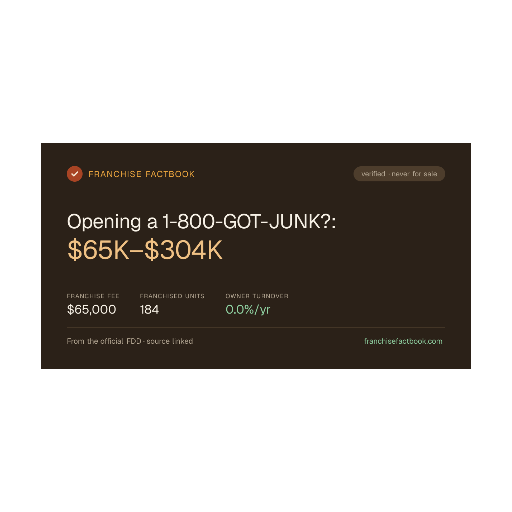
1-800-GOT-JUNK?
1-800-GOT-JUNK? LLC, a Delaware limited liability company, franchises U.S. businesses that remove and haul non-hazardous junk for disposal, reuse, or recycling. The brand says these businesses serve homeowners, property managers, contractors, realtors, and other businesses. The franchisor says it has no other business activities and has not operated a business of this type.
- Estimated Startup Cost
- $182,300 to $303,500
2026 FDD